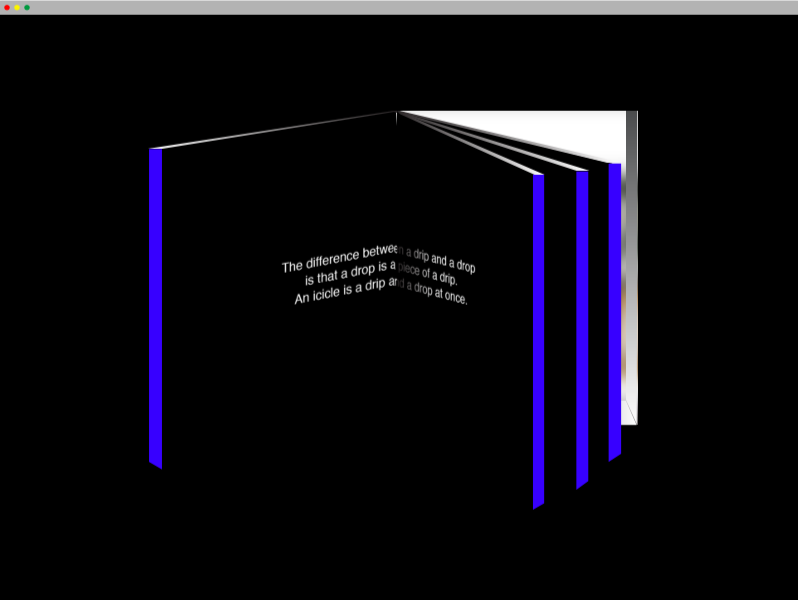
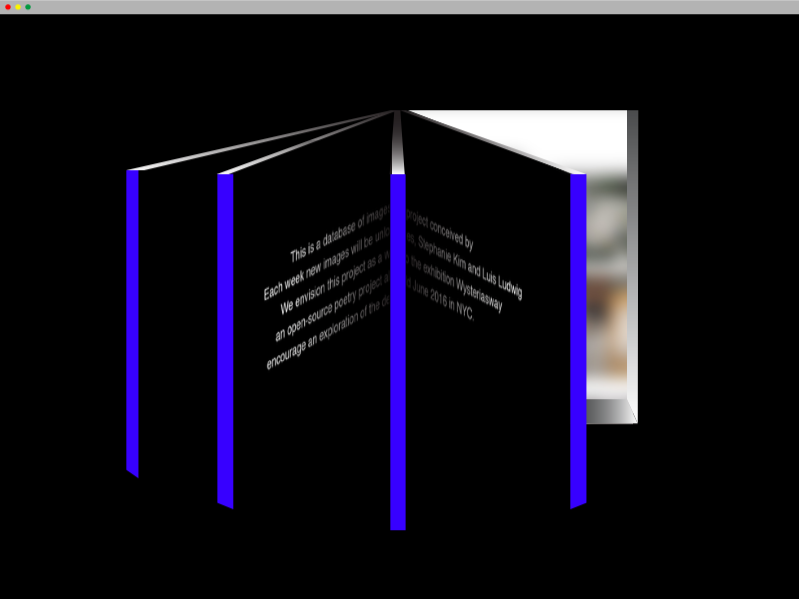
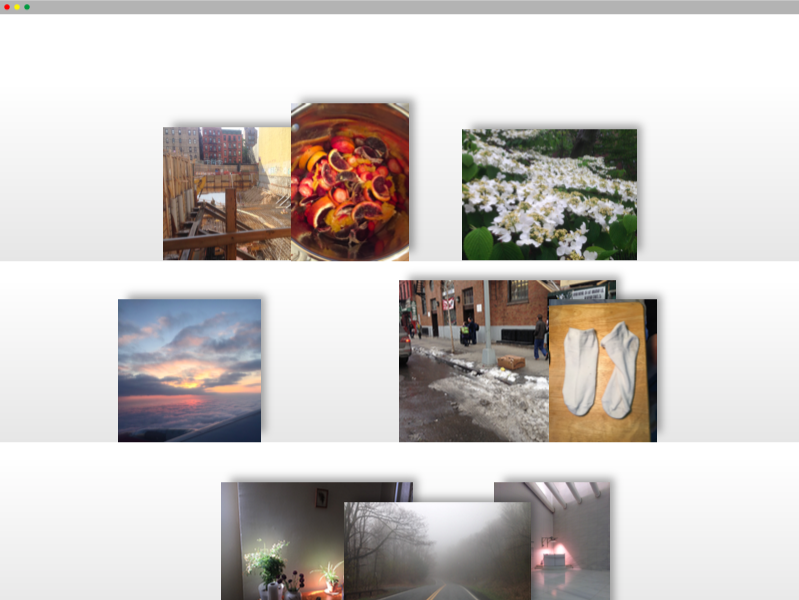
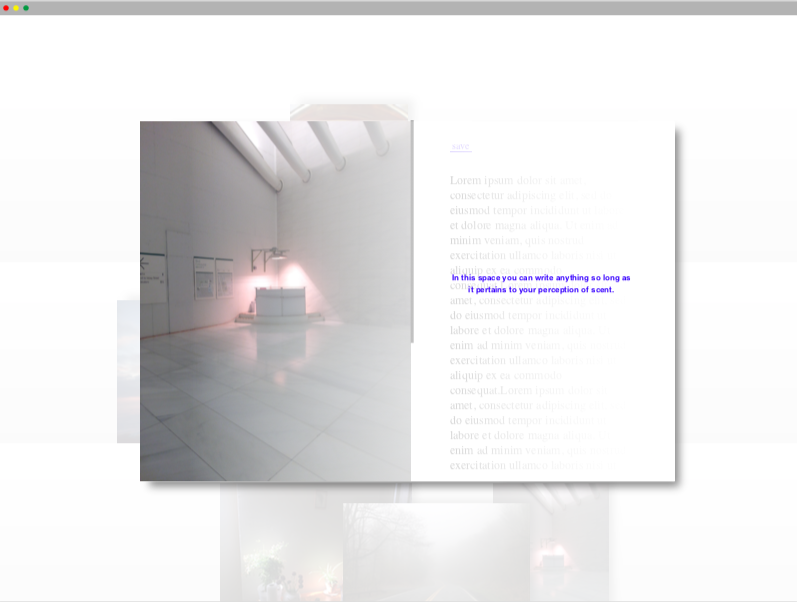
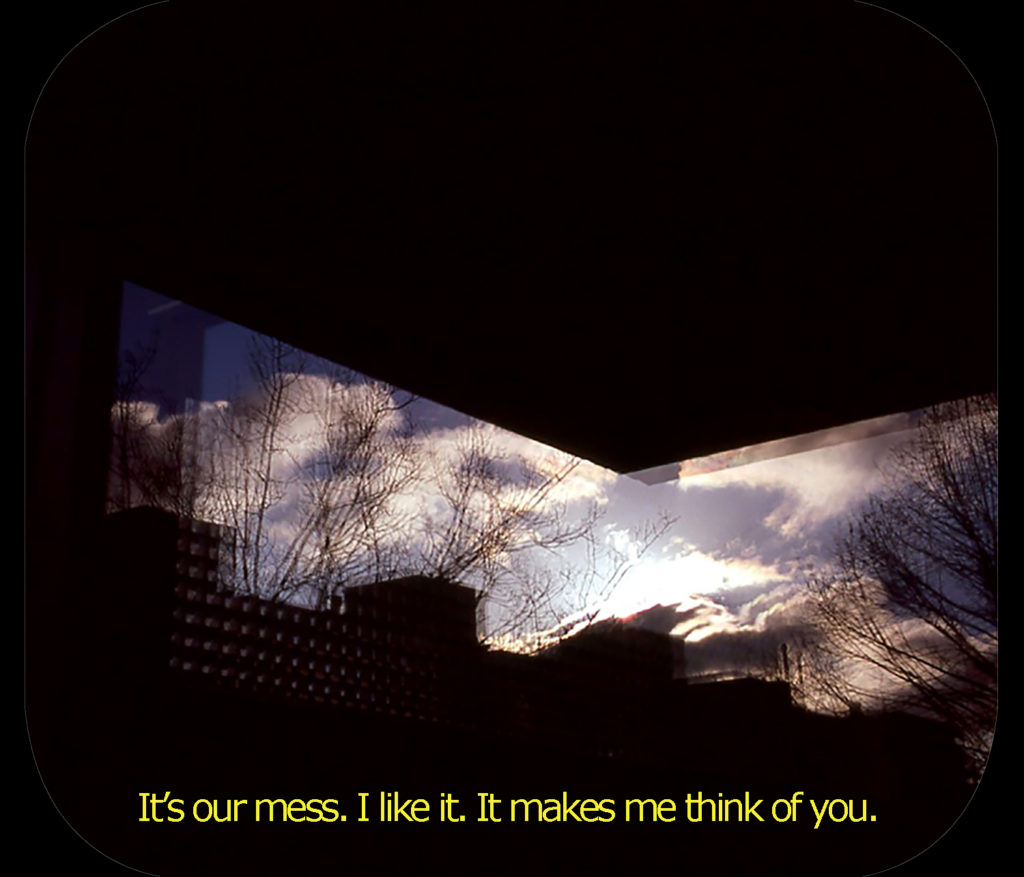
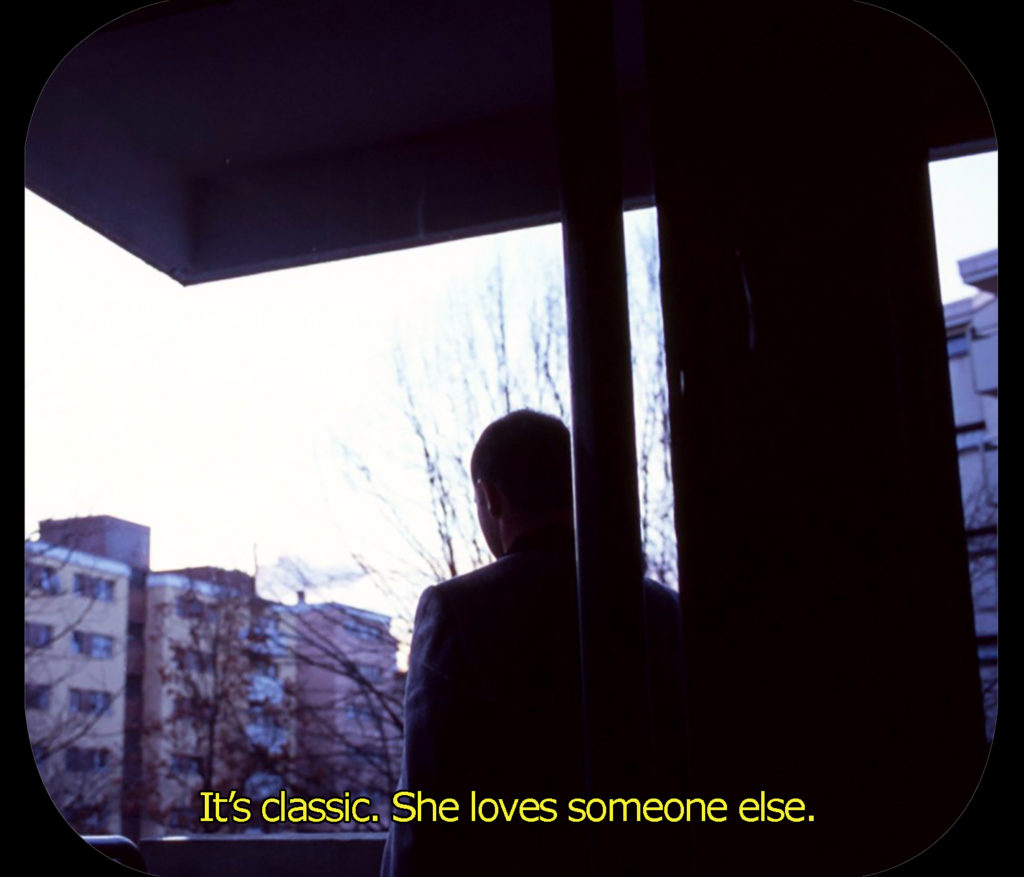
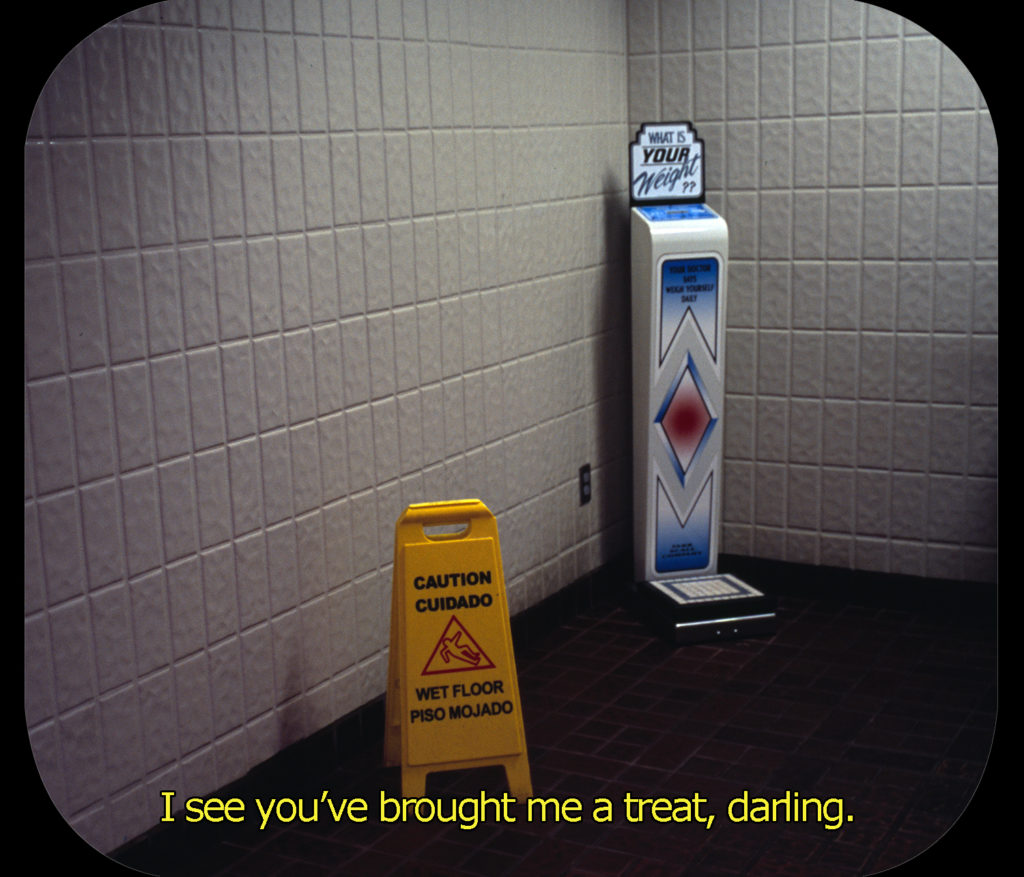
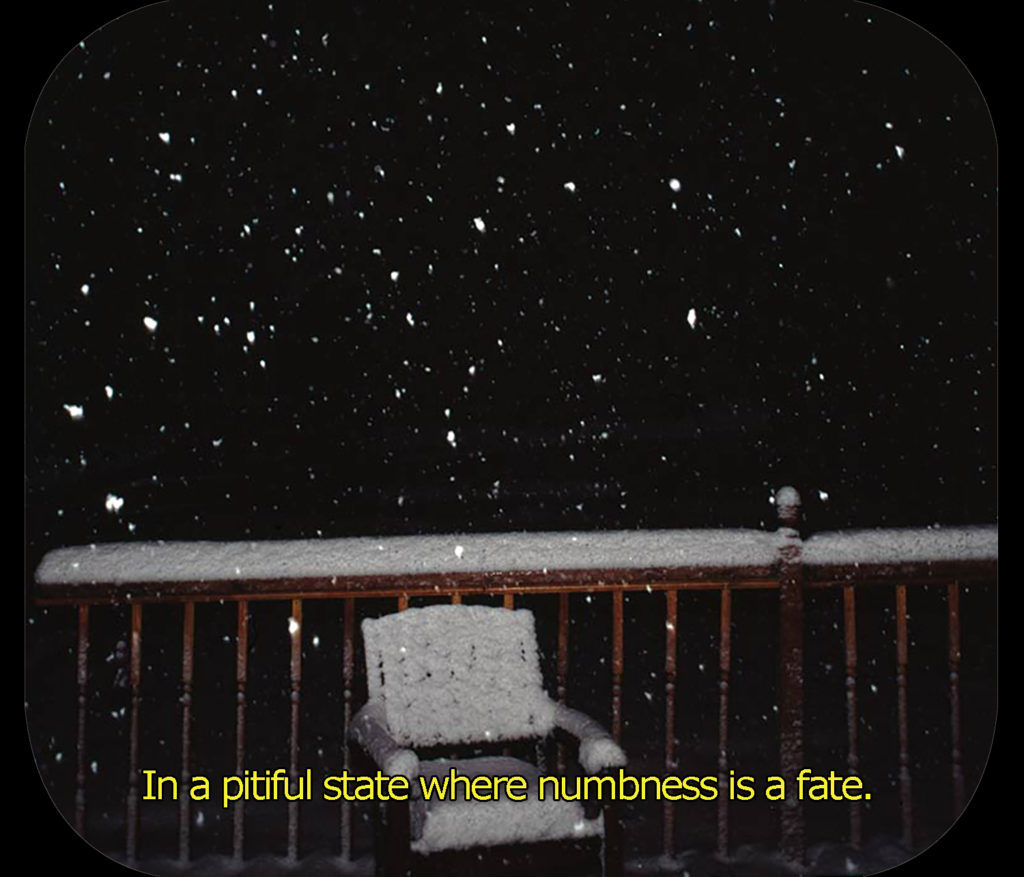
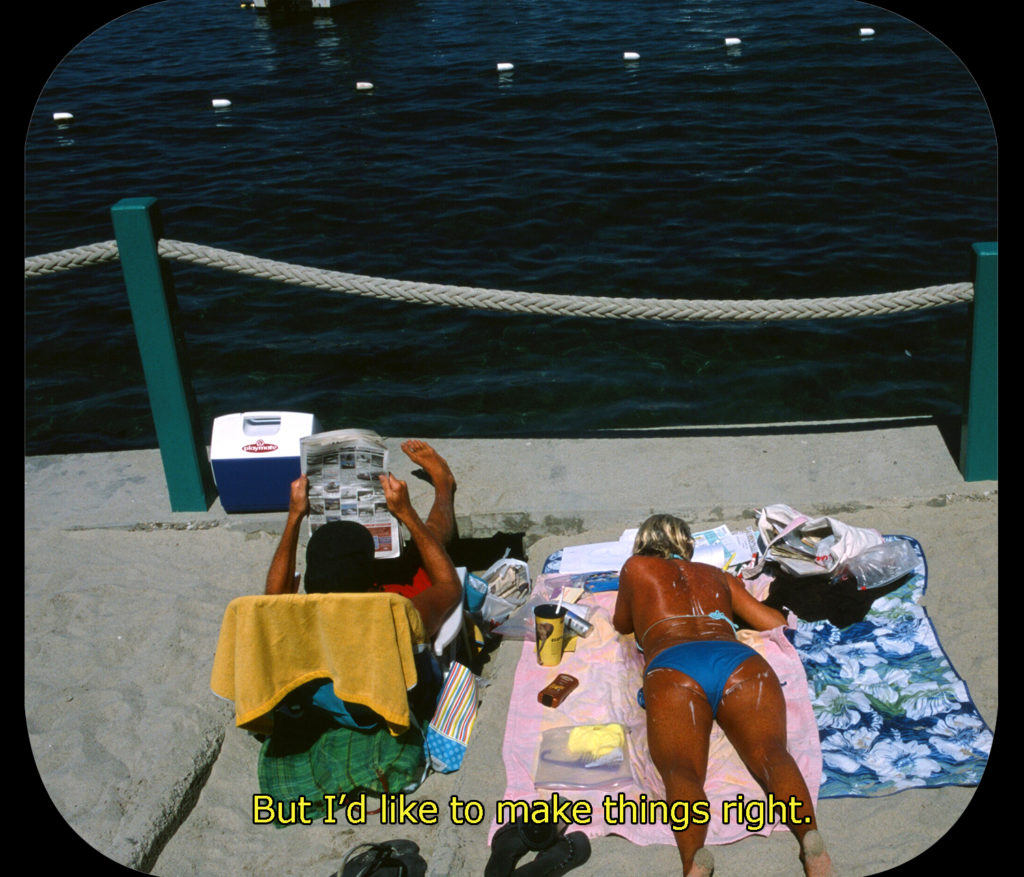
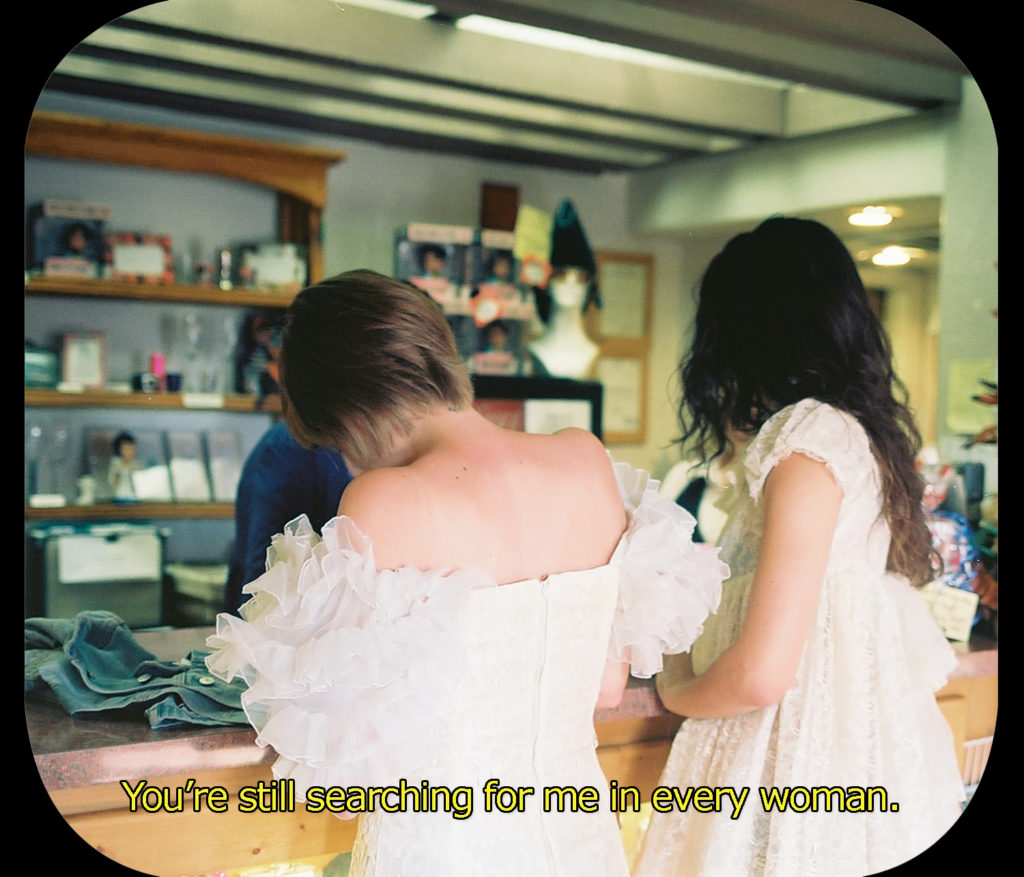
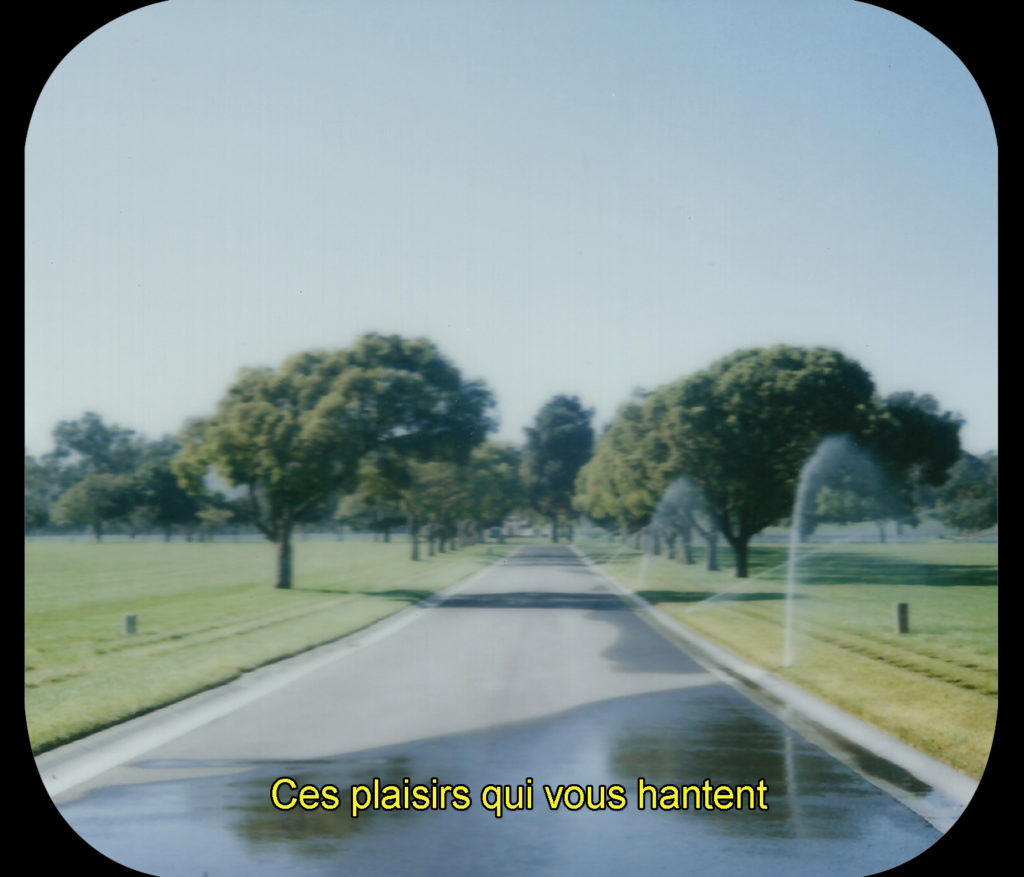
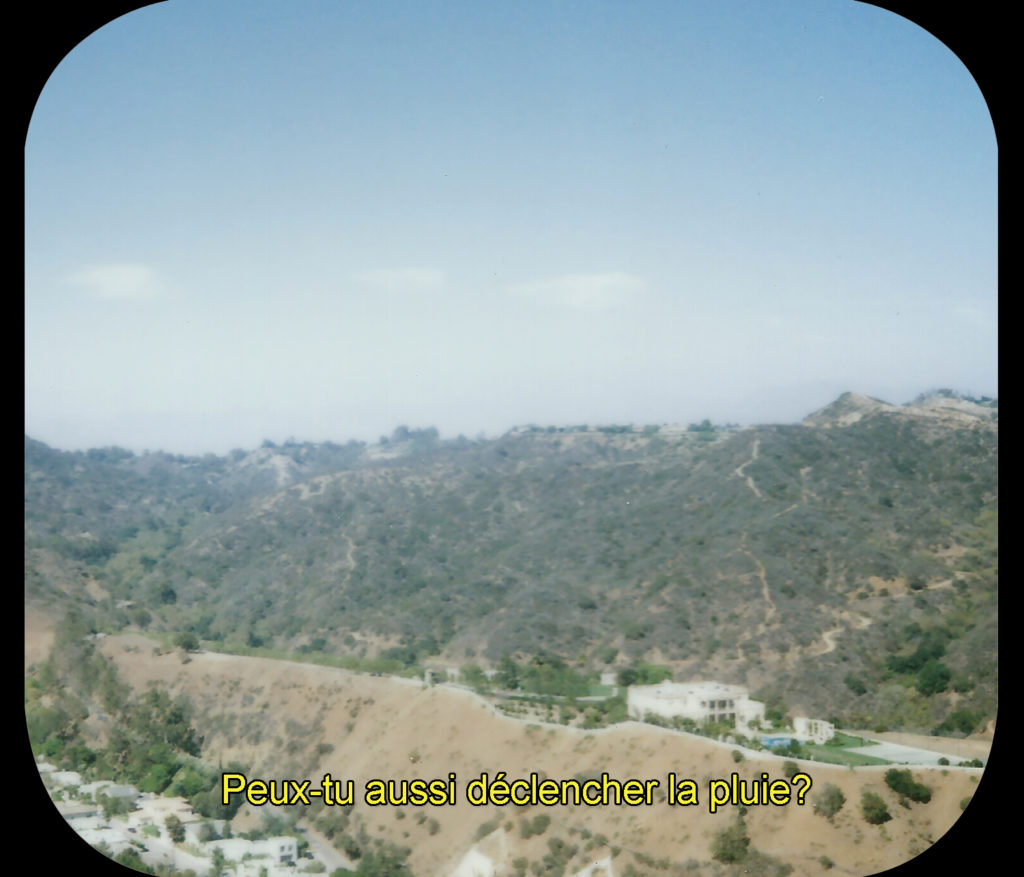
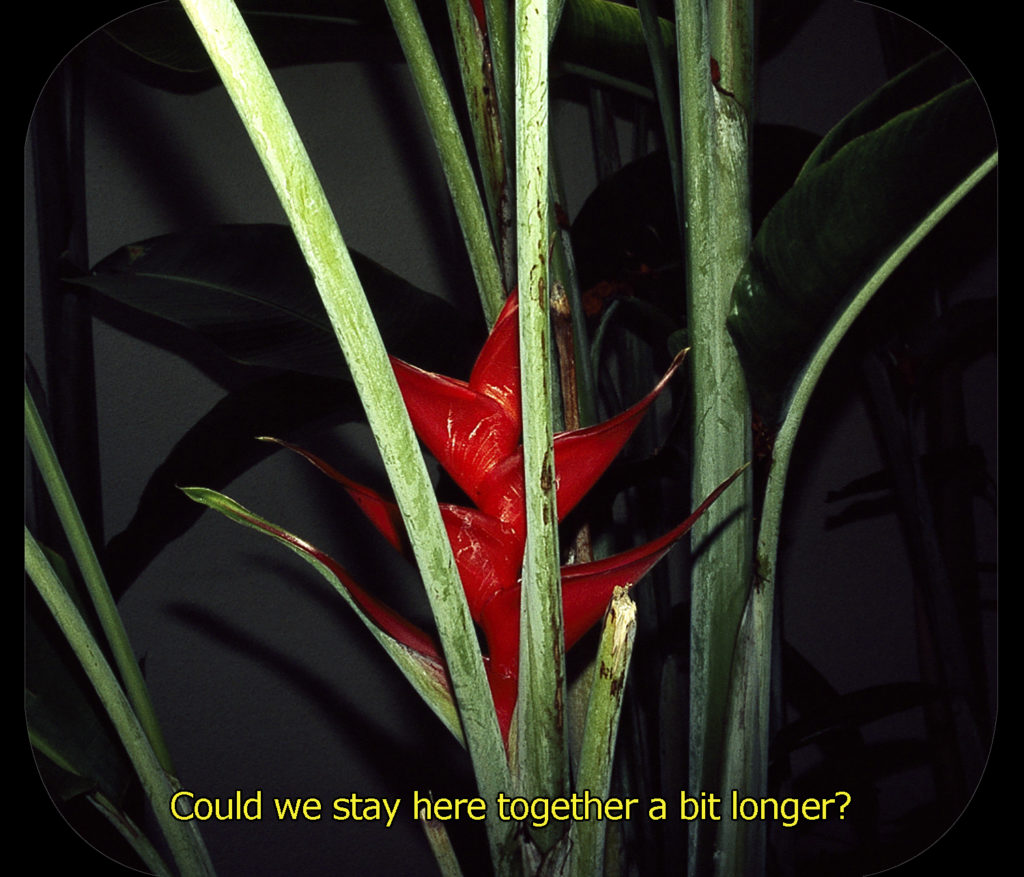
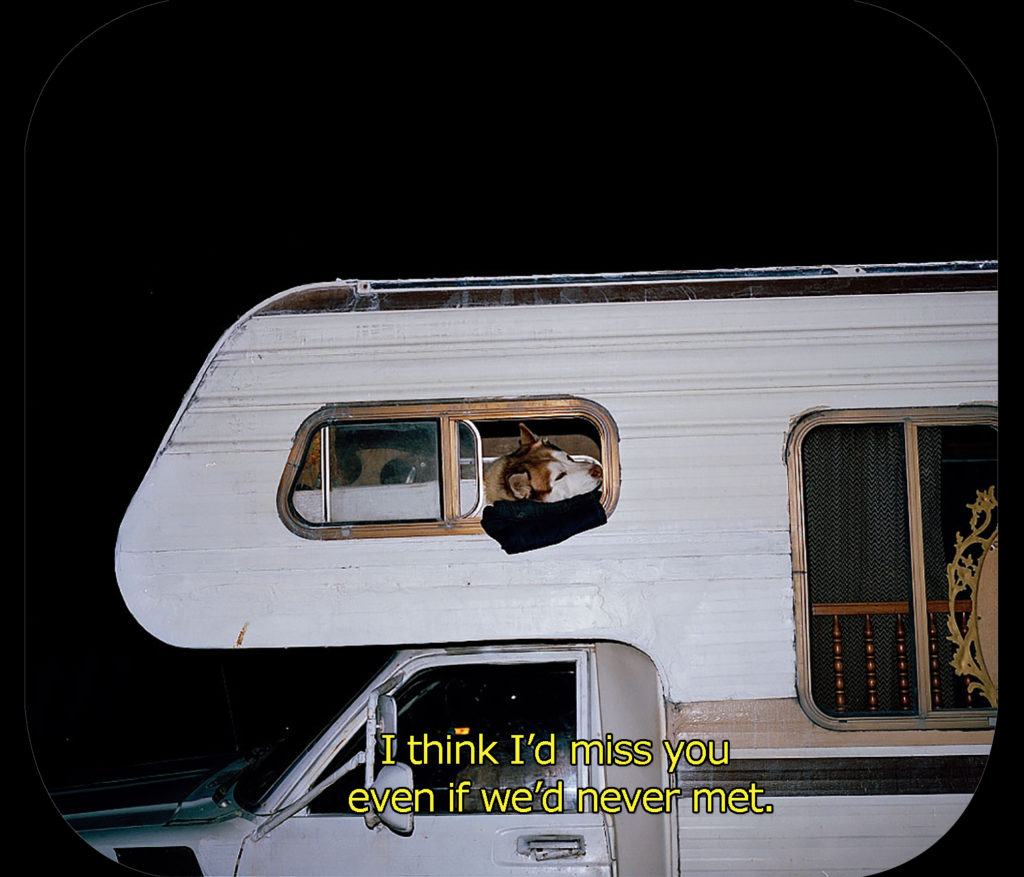
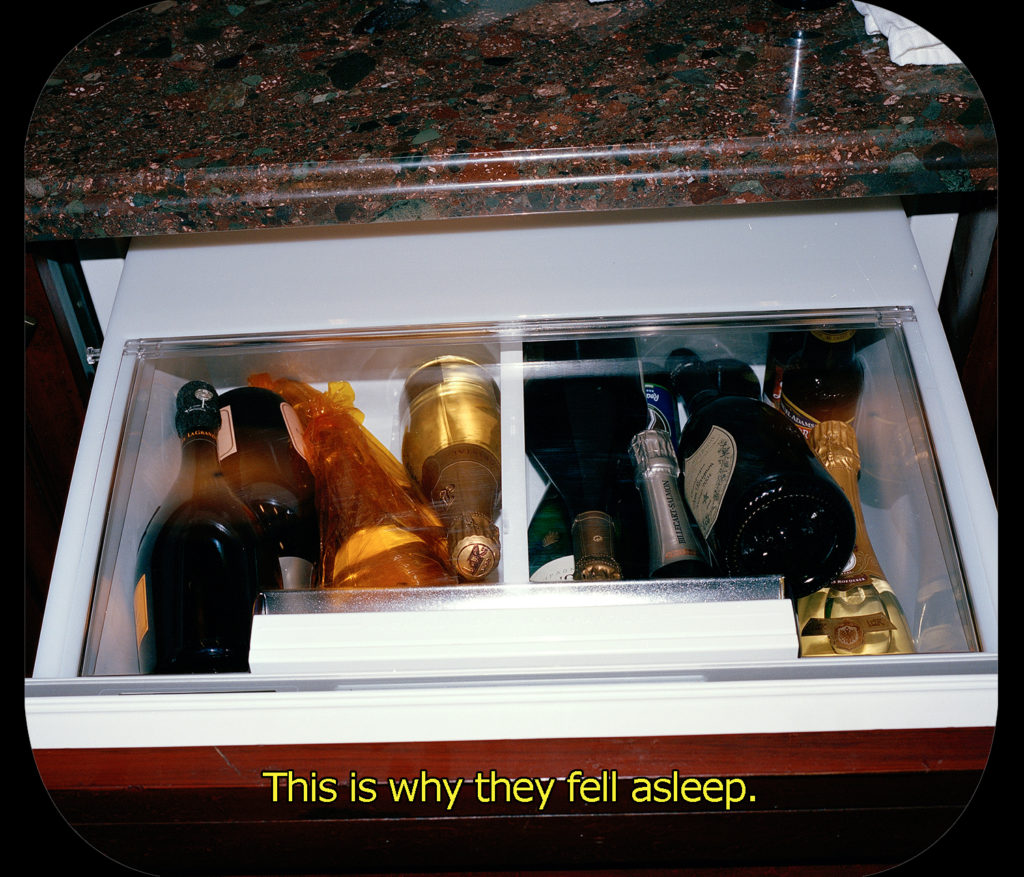
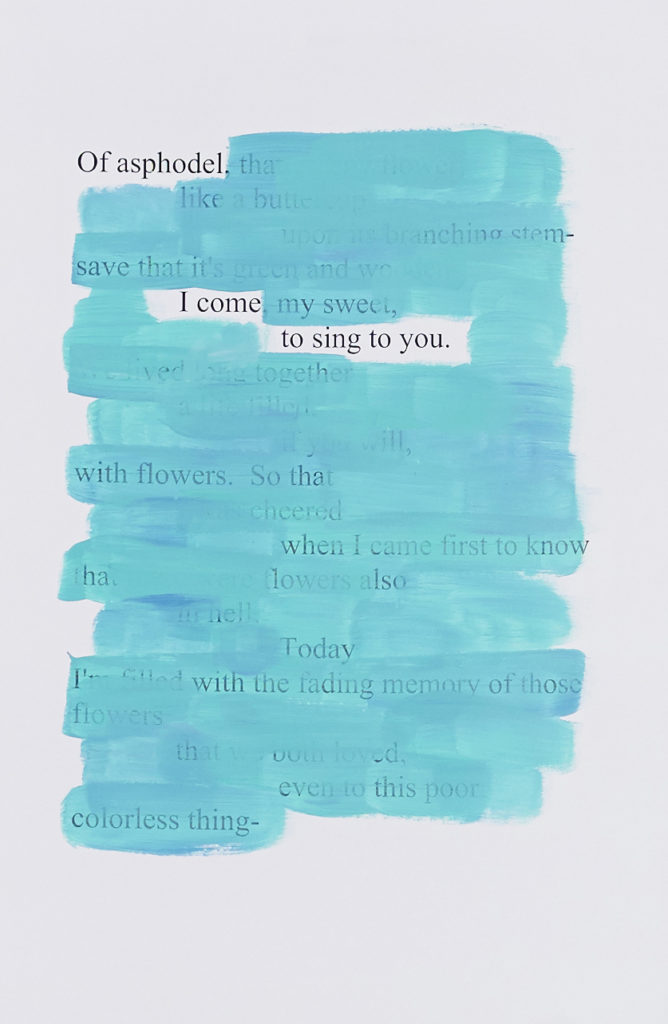
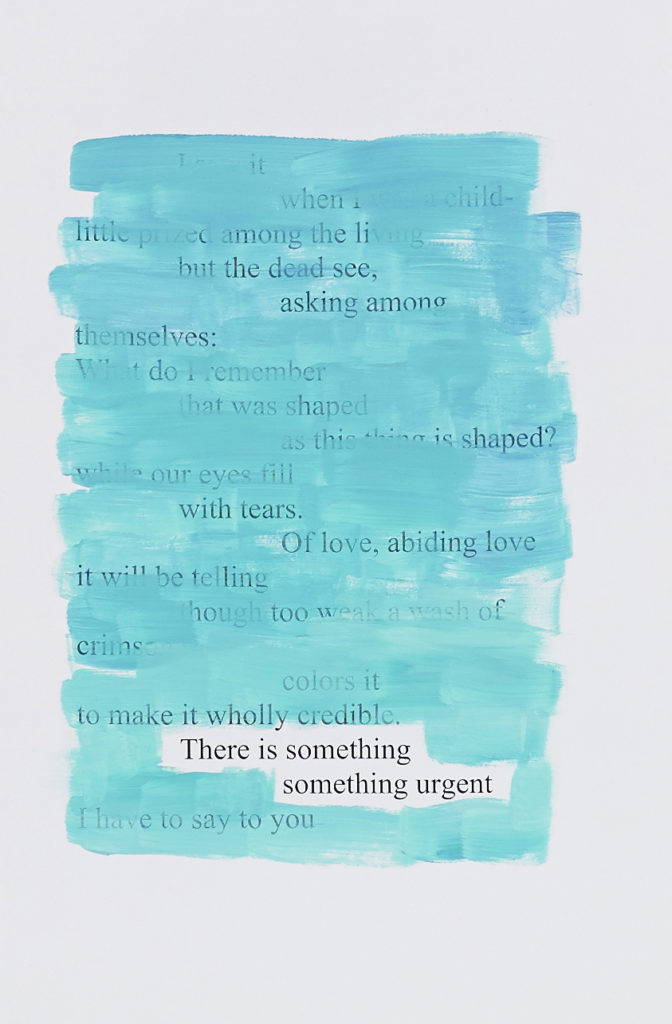
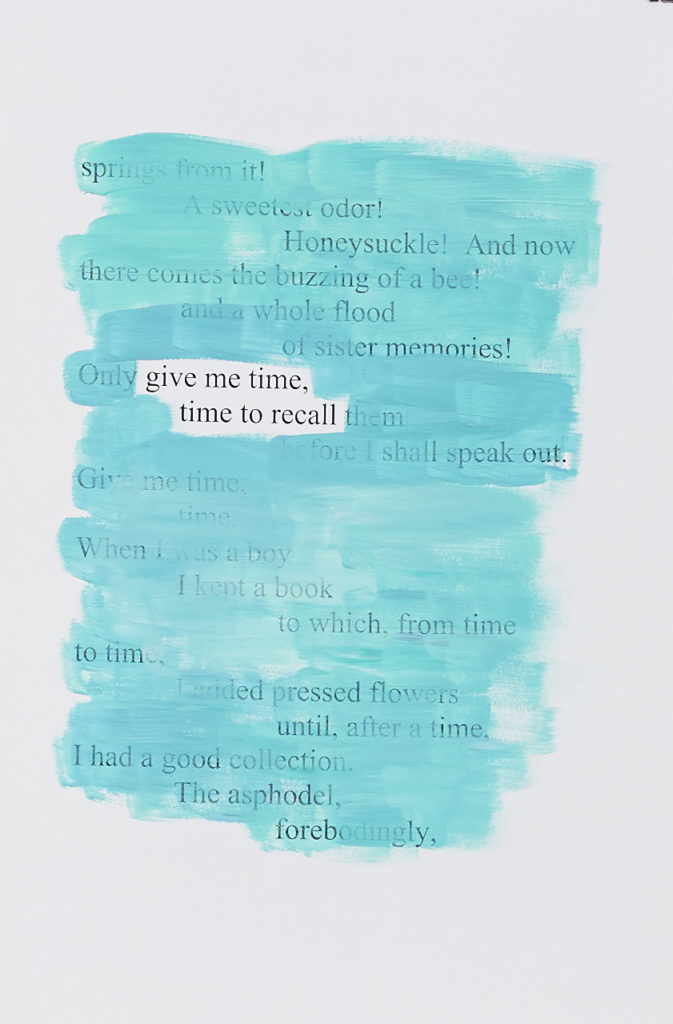
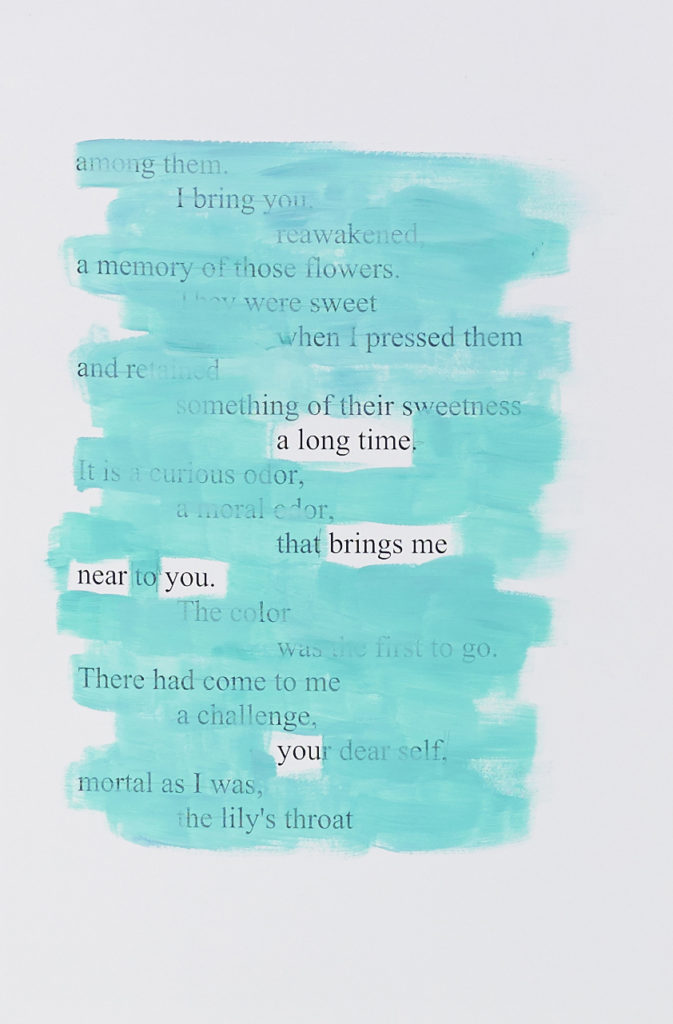
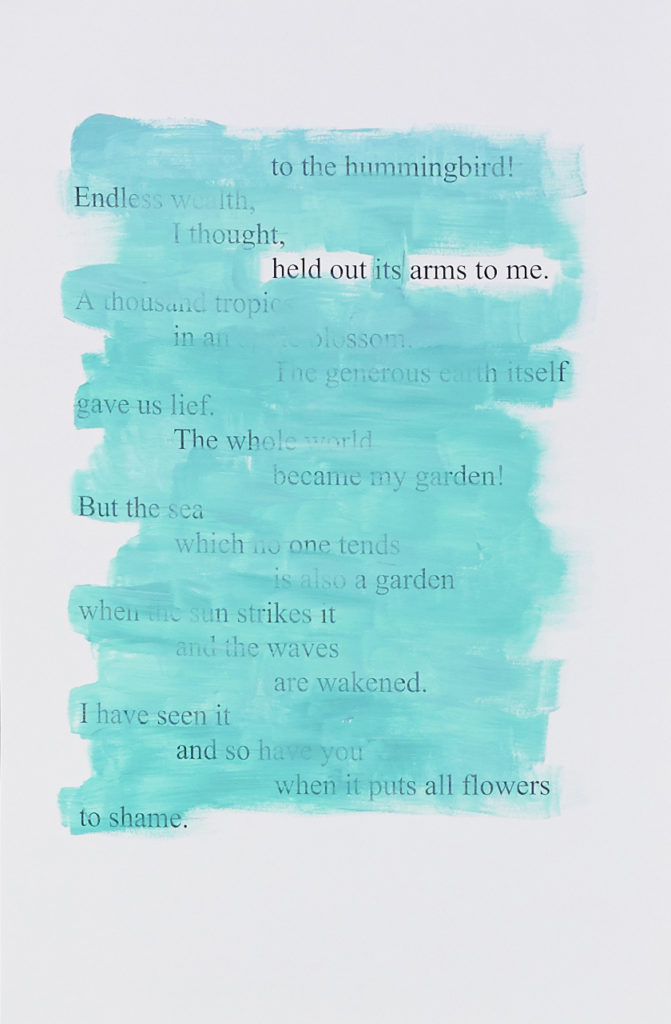
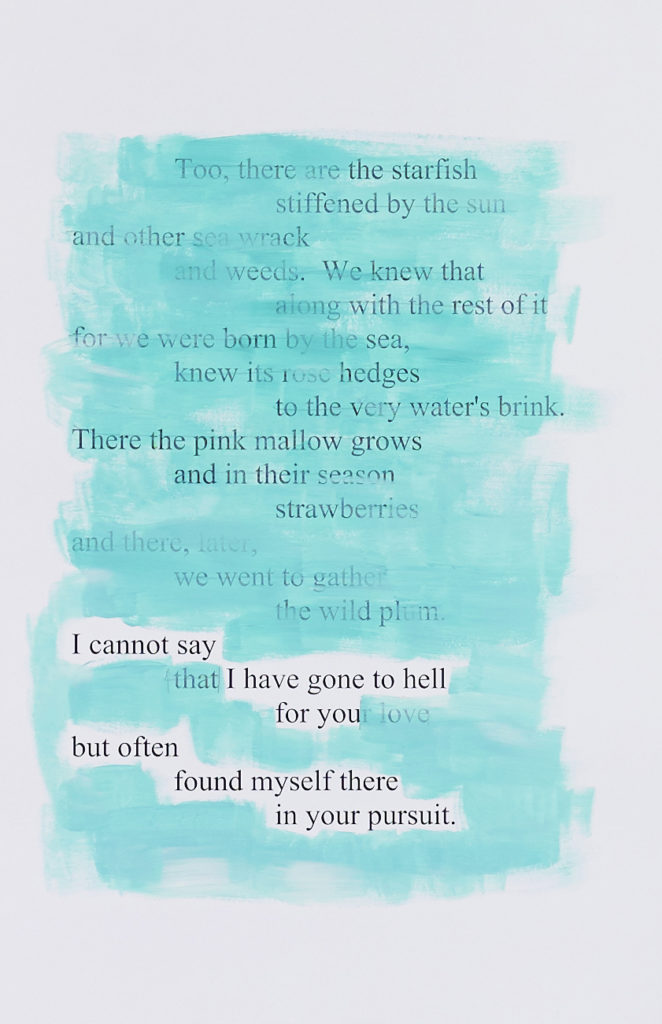
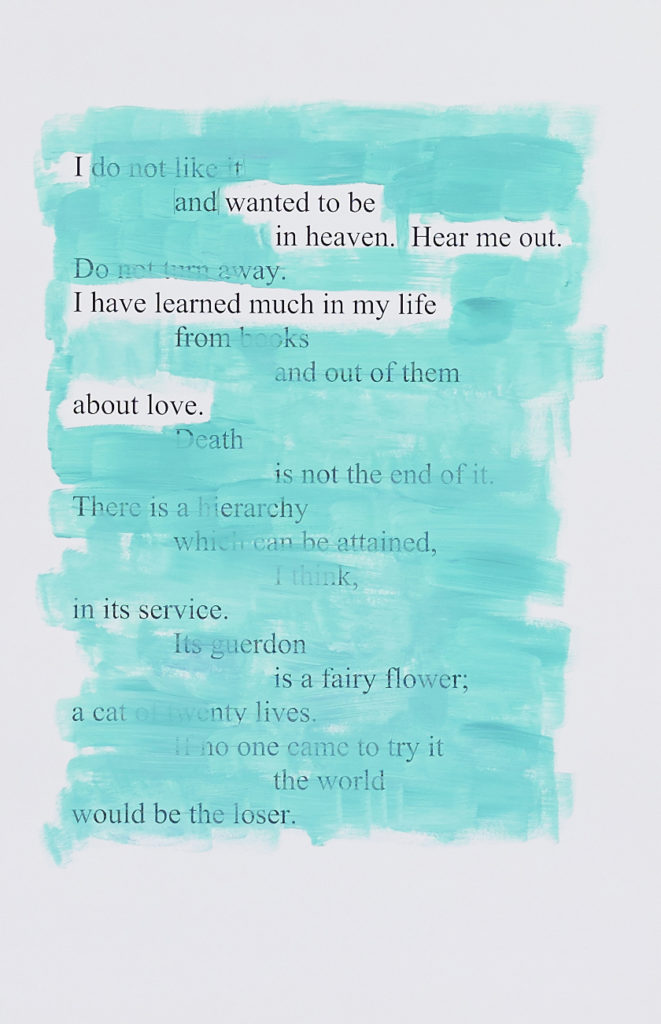
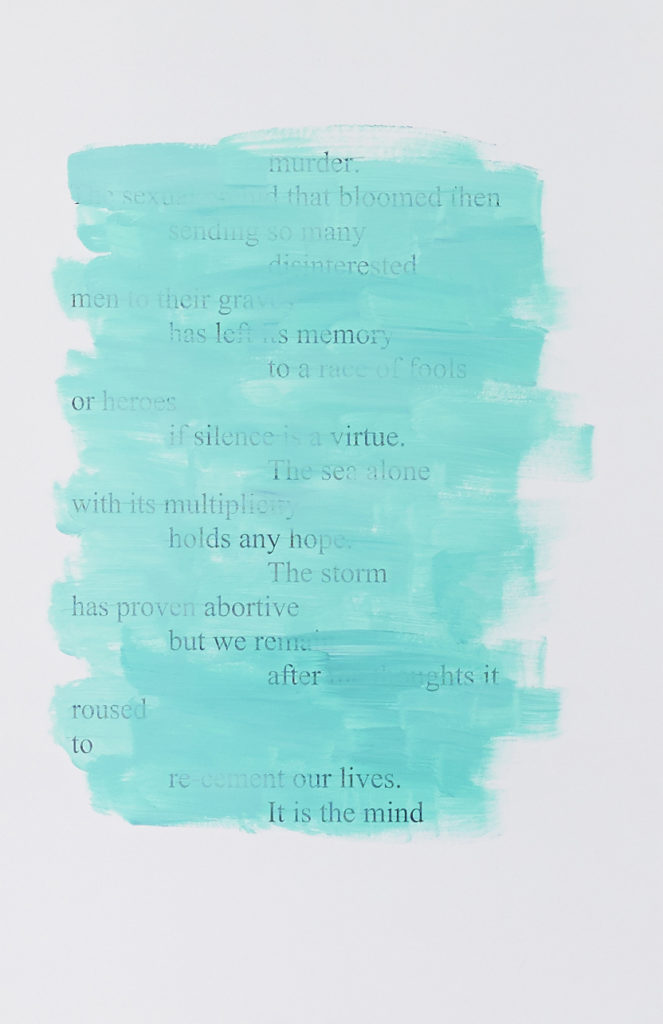
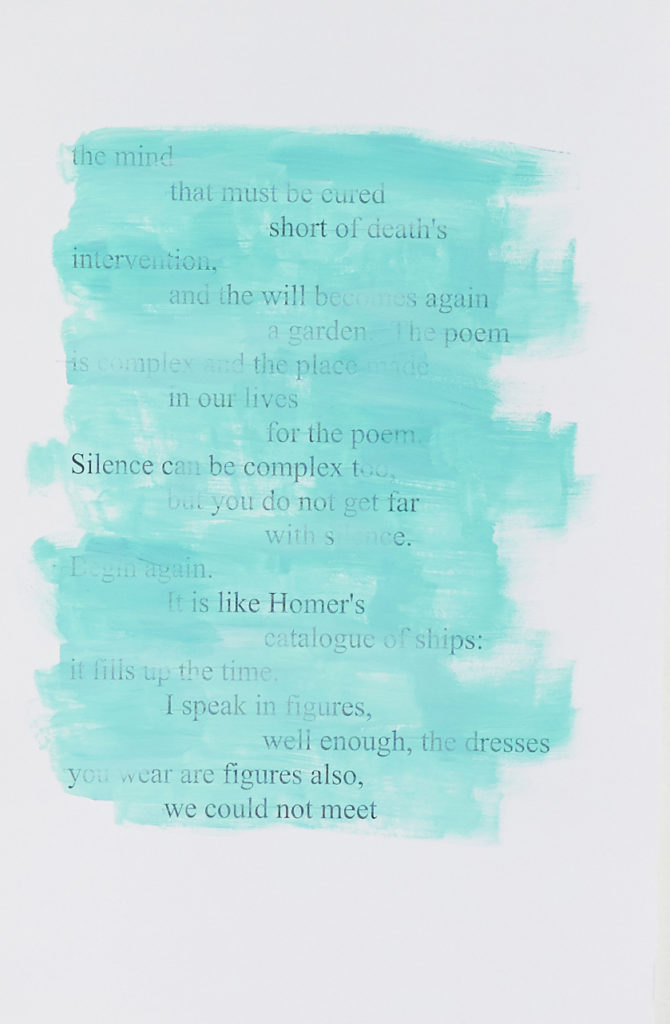
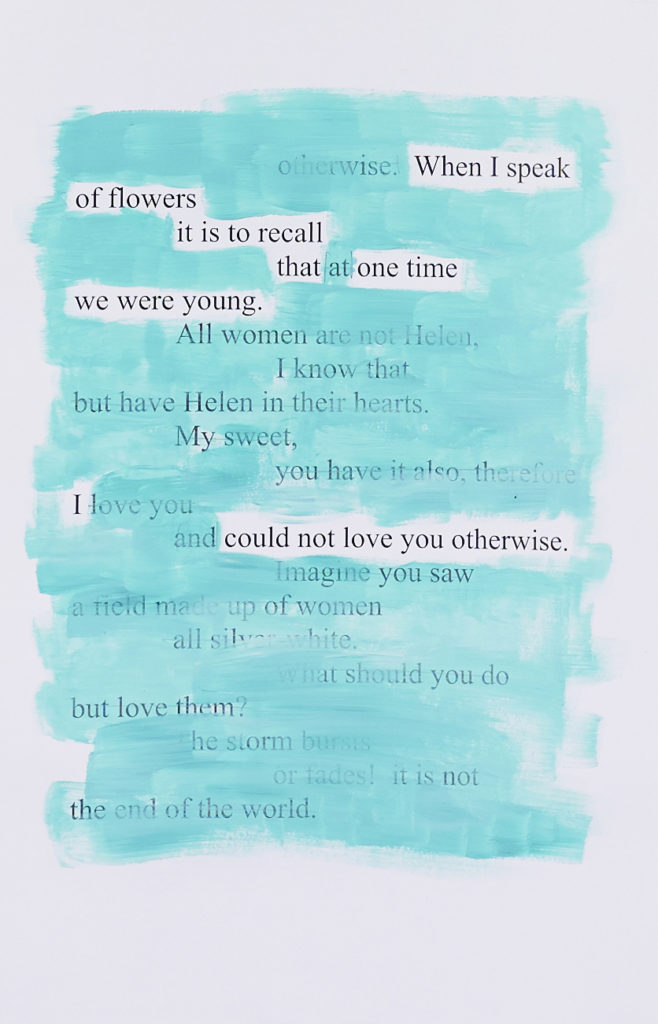
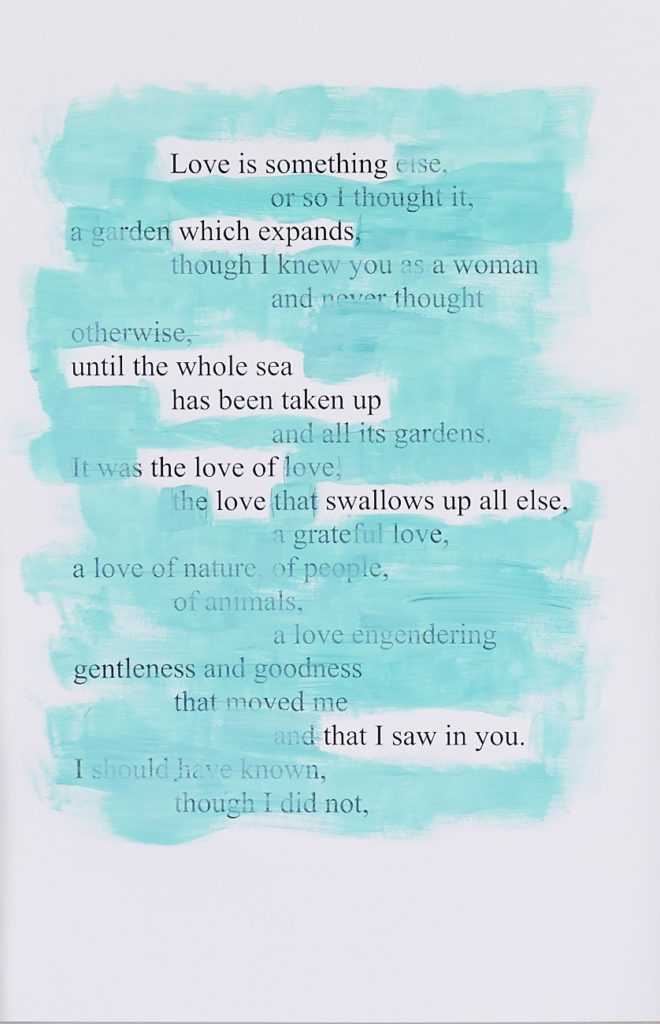
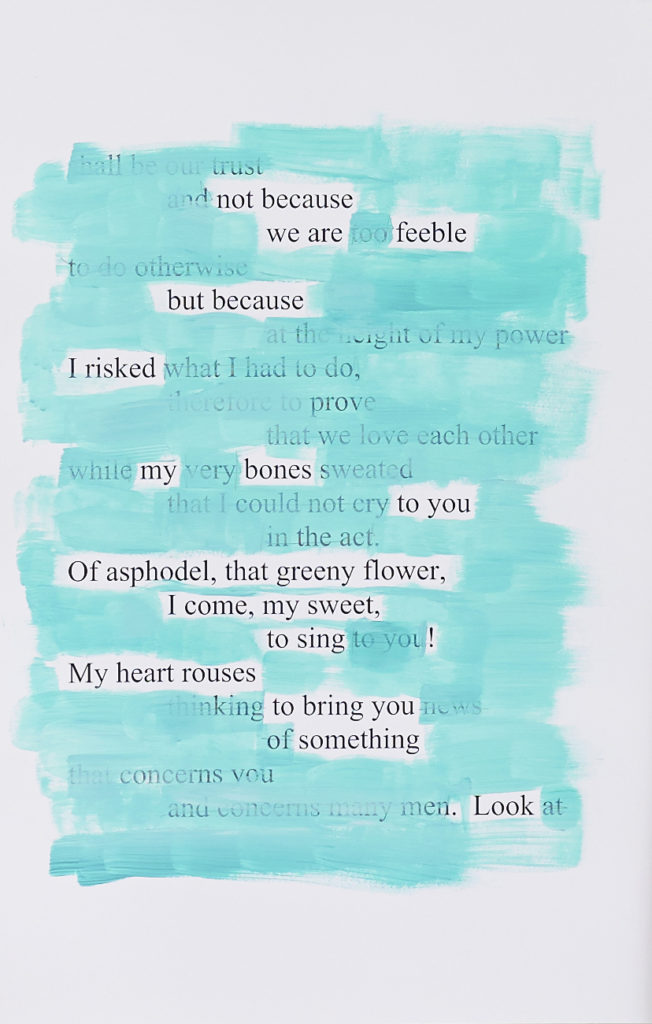
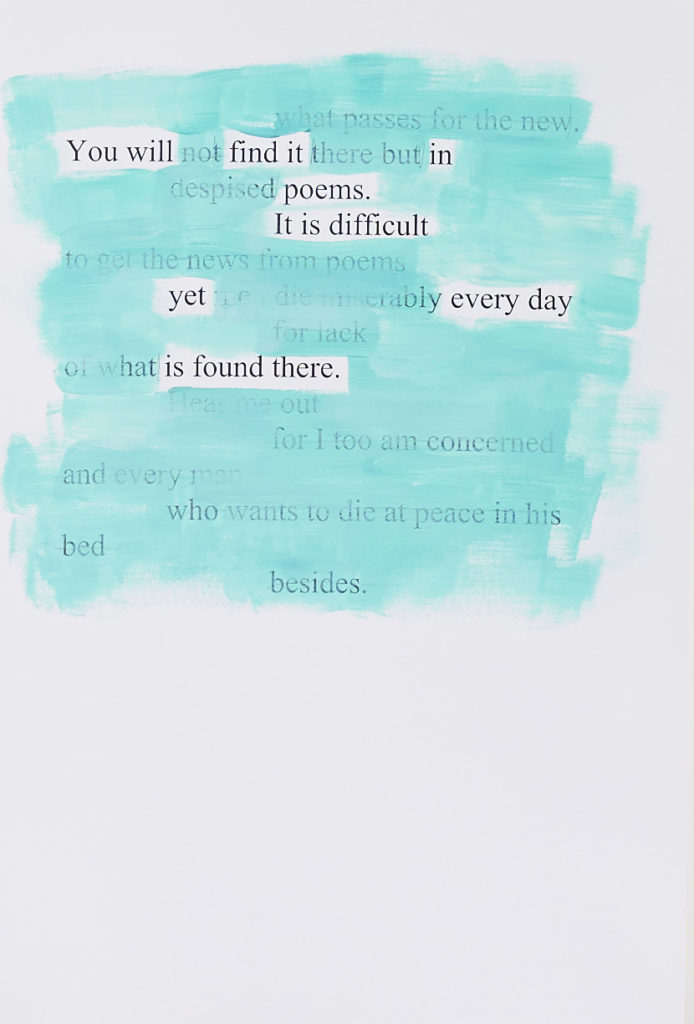
babyicicles Ficus Interfaith Research & Properties, Stephanie Kim, Luis Ludwig 2016 · web project, proposal An addendum to Wysteriasway. The site expired; screens below are from mockup.
About
babyicicles is a web project conceived by Ficus Interfaith Research & Properties, Stephanie Kim and Luis Ludwig. It is an addendum to the exhibition Wysteriasway by Ficus Interfaith.
Instructions
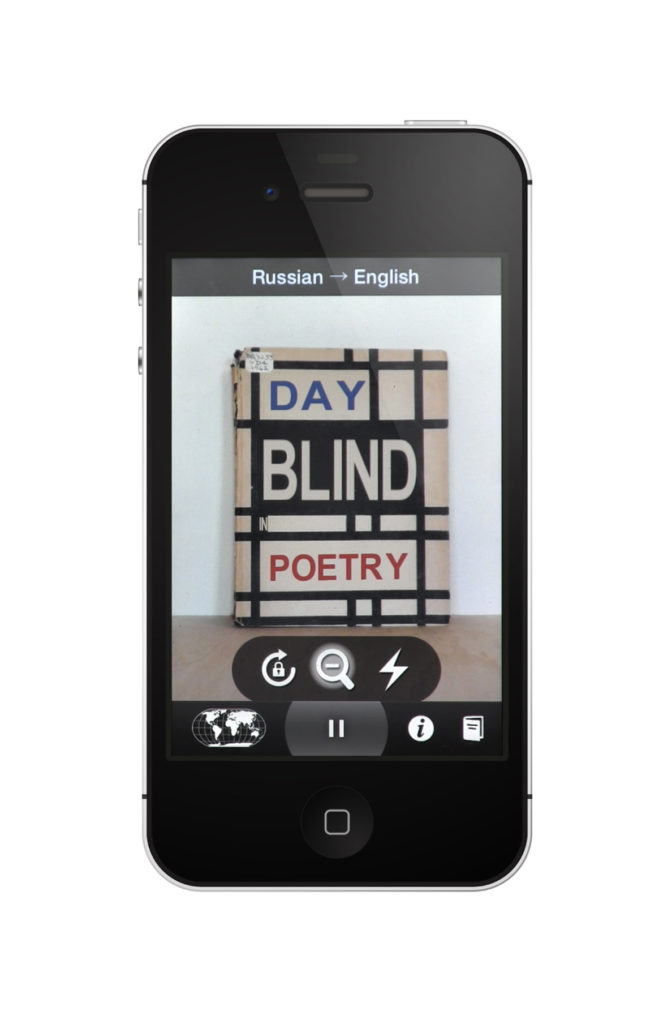
babyicicles makes use of images from Ficus Interfaith’s ongoing potpourri research to instigate fresh open-source poetry. Each week new images will be unlocked for comment and collaboration. You may write anything so long as it pertains to your perception of scent. Over time the images will be sealed and archived. The game is meant to encourage adventure in the way we use language to describe and understand our olfactory experiences.
The difference between a drip and a drop is that a drop is a piece of a drip. An icicle is a drip and a drop at once.
High Brow Low Fish Consumption
High Brow Low Fish Consumption Text by Tyler Steinbrenner Illustrations by Ficus Interfaith June 2016 149 Canal Street, New York
The transcendent object descending from on high—its glimmering surface blinds the gathered masses, prostrate to its desirous intangible form. The wilting lilies stand anew and launch into impassioned speech while the stoic silently weep, the children gaze longingly. Free at last, free at last—the network has come to save us from our abject containers, here at last to unite us in ways both bold and true. It has always been our unforgiving materiality which has divided us in the end. The limits of my reach always delimited by the wingspan of my fragile arms—my potential forever stunted by the limited volume within my meager chest. The internet as shiny ulysses, dripping with honey, shining like a thousand suns. A universal forum, the digital agora.
Behold the horrifying logic of the network. Ae are all equally different within its reticular spread, assumed to be perfectly the same—totally deracinated and utterly vulnerable to the accumulation of power. The resonance of true intensities—the machinations of which are cloaked by its undulating mesh. How may we re-orient ourselves as we are inundated from all sides, orifices engulfed with the poisonous “common fluid”? To put it plainly, where and how do we begin to assert ourselves within such a pernicious cycle?
The internet is a red herring. This is not to dismiss the accommodations it affords us—increased potential for communication and trade globally amongst other valuable capabilities. The internet did, in fact, allow for the emergence of new communities to emerge and opened up discussive spaces unavailable previously. It also “de- materialized” many functions of everyday life and therein lies the problem. The problem is not that the internet truly dematerializes the everyday or that it disembodies labor but rather that it hides the material conditions and mechanisms that allowed these functions to be enacted.
There lies beneath the surface of the ocean, creeping in obscurity between all continents, cables of unimaginable lengths. These cables are themselves the arteries of the internet, fiber optic cables that bring it stability and speed on a global scale. Similarly, the data that inhabits the internet is stored on web servers, in various locations all over the world. Behold, the internet has a body! Sever those cables, bomb those data centers and quickly the ineffable hydra of the “cloud” is vanquished. Of course, our aim is not to destroy the internet, but perhaps it is to dismantle capitalism and the fact of the internet’s fundamental locality and materiality may provide us with an operational model by which we may act in the present. If we can understand that the internet itself is bodied, what then can we understand about its true power? The network has an incredible potential for organizing dispersed beings. Think of the Arab Spring—what traction would it have gained had the protest been comprised only of texts 140 characters or less? It is when the immaterial network is embodied, transfigured onto the streets with fists and shouts, that a contemporary revolution becomes manifest.
Network capitalism is a red herring. This is not to say that late capitalism is not indeed increasingly powerful or dangerous. It is also not to say that late capitalism is not accelerating rapidly. What it is saying is that network capitalism is actually no different from your garden variety capitalism—that it operates on the same modality of pure exchange—the demand for complete sameness of all its constituent individuals or nodes. It is an incredibly successful red herring because it has recuperated our last great hope, that of multiculturalism. One would say that multiculturalism is the protest of total difference, the complete locality of individuals, and that, through the egalitarian proposal of the network, capitalism has swallowed that difference whole. Yet one must look more carefully at the kind of difference capital has seemingly ingested, the multiculturalism that it has absorbed is one wherein difference is countable, or reducible to the digital. This is not truly difference but rather the apprehension and knowability of total locality. This is not difference itself. Difference is not an income bracket or a rubric of ethnic inheritance. It is the undeniability of experience, the irrefutable dimensions of our coordinates upon the universe of things and events.
How then may we reconcile ourselves within the supposed immaterial framework of a global network and the materiality of our homes? Perhaps it begins by a two-part utterance. It is not to say, “think global, act local” but rather “act global, act local”. The problem with late capitalism is that it pushed locality to the far margins, making it only apprehendable on a totally local scale (as with various DIY movements). Simultaneously, it has increasingly cleared out the center, the public, as a viable space for asserting difference through var- ious modalities of policing (i.e. corporate security within Times Square). It is therefore our responsibility to assert ourselves as different by promoting locality within the global space—to maintain a fervent and specific sense of one’s “home” online. In tandem, we must also propose a type of universality within the regional. Organize a group show in your hometown (or in the woods for that matter) comprised of artists from around the world. The world is constituted of irreducible difference and the marching order is to see ourselves as not equally different but differently equal—that no one may be exchanged for another but that all must work to relate upon the grounds of our true commonality—the fact of our shared existence.
Towards a Theory of Aesthetic Justice
On a spring morning in 1972, thirty-two high-rise apartments come crashing to the ground. Smoke, atomized concrete and fragments of beloved objects left behind stand frozen in time, then are propelled outward, twisting through the air, by the power of the dynamite laced through the building’s skeleton. Nobody is left in these apartments when they fall. They had been slowly evacuating for a long time: residents leaving as memories of violence, both singular and systemic, overwrote former sites of community. These walls, stairs, pipes, wires have failed so thoroughly to protect the living bodies who inhabited them that, according to the state of Missouri, their total annihilation is necessary. The towers were praised just two decades before as an exemplar of modernist architecture used for social good. Now, they are turned into rubble and dust that disperses in a cloud.
What comes after the high-rises fall? With the advent of postmodernity, we saw the partial disintegration of a violent universal—the Western subject—a monolith more difficult to deconstruct or to pulverize than the failed housing projects in Missouri. With the end of modernism, the white male colonizer came under critique from all sides. A multitude of subjects pulled back the curtain to reveal a Wizard of Oz, a hunched and impotent figure at the controls of a massive, suddenly absurd green mask. Postmodernity did not kill the Western universal in-itself, but perhaps it poisoned it by revealing the violent apparatuses by which its universality is accumulated.
But these full-throated critiques saw their heyday forty years ago. We now stand at the point of exhaustion. A poisoned universal is before us, and its sickened body seems not necessarily worth saving. And the same violent apparatuses of oppression are as robust as ever, despite the atrophy of their totalizing organ; the poison seems to have missed its mark. It is at this moment that critique appears of contemporary art’s indeterminacy, relativism, subjectivity, the lack of criteria for evaluating value. The argument is made that multiculturalism—the explosion of difference that rebelled against modernist standardization—has been recuperated by late capitalism. The language of protest appears in McDonald’s commercials, and every stock image of the professional workplace displays an unimpeachably diverse composition of ethnicities and genders. Of course everyone is different; everyone is just as different as everyone else. Now, would you like to buy this shampoo for girls who went to public school in the 1990s?
There is a problem with this, though: recuperation has a remainder. There are things picked up and things left behind, indigestible bits that must be spit out. What type of difference did late capital- ism swallow up, and what will it find undigestable?
We say that multiculturalism has been recuperated by late capitalism, but that recuperation has not been thorough. When problematizing the indeterminacy of contemporary art, the target should not be subjectivity-in-itself, it should be power: the structures of oppression laid bare by political critique that still persist. Establishing criteria for art on the shifting sands of our contemporary rubrics of value is impossible not be- cause multiculturalism has been thoroughly territorialized by capitalism, but because difference is the ground on which capitalism is being undermined. True difference, constituted through communal encounters and an ethical engagement with the other, is a poison pill to capitalism. It is only its reduction — difference-without-another — that can support large-scale exploitation of laborers, the abstraction of objects away from the materiality of their production, the conflation of the subject with pure exchange value.
The indeterminacy of critique we see is a fissure in the ability to accumulate sufficient cultural capital to create and enforce categories of value. Contemporary art is indeterminate because capital is losing its power to wholly determine. This is to say that contemporary art must concern itself with justice. The context of its indeterminacy is the growing chasm between difference as represented by capitalism—a difference that totalizes— and true difference-in-relation. And to work towards stability, the artist must throw their weight to one of these poles. Aesthetics oriented towards a justice of difference do not necessarily have to be political, or didactic: there are a multitude of just practices. But a contingent ethics that recognizes our time as a time of flux is necessary.
Difference and the universal are not opposites— there simply exists a certain discourse of universality whose antithesis is difference. Jettisoning the universal by mistaking this part for the whole was the mistake of postmodernism. Universality and difference are both integral to relation: we emerge as individuals through a transcendent recognition of the Other, of someone outside of ourselves. We are distinct individuals born out of the shared potentiality that preceded us. Moving forward, we need a revitalized universal constituted of difference, an ethics that manifests from the entanglement of all things.
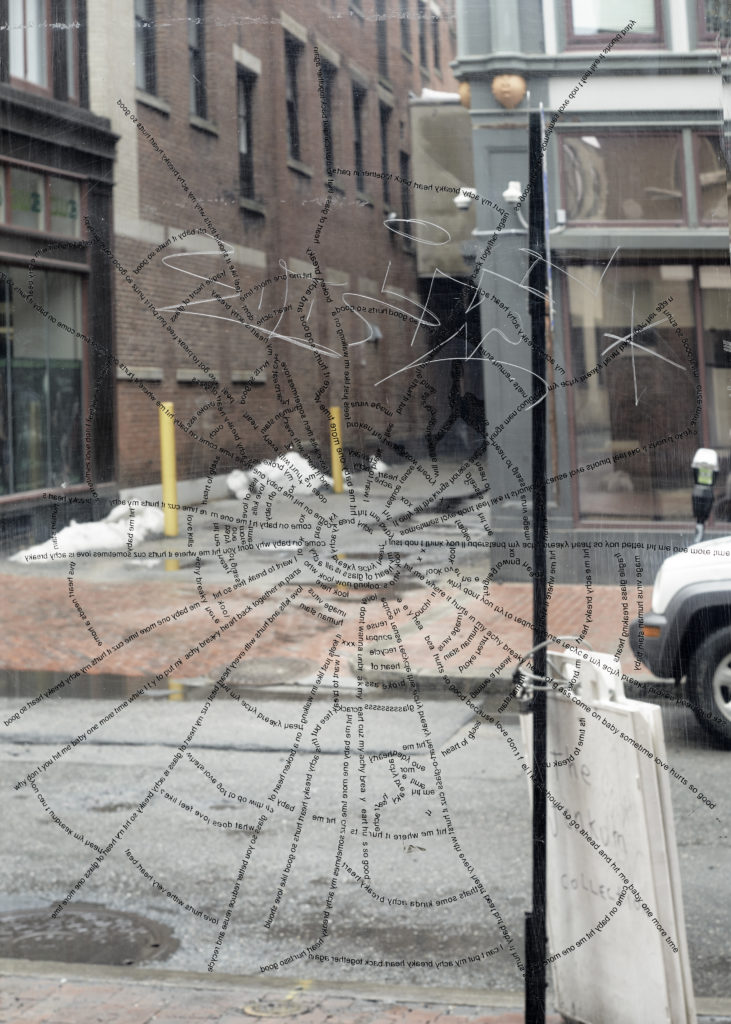
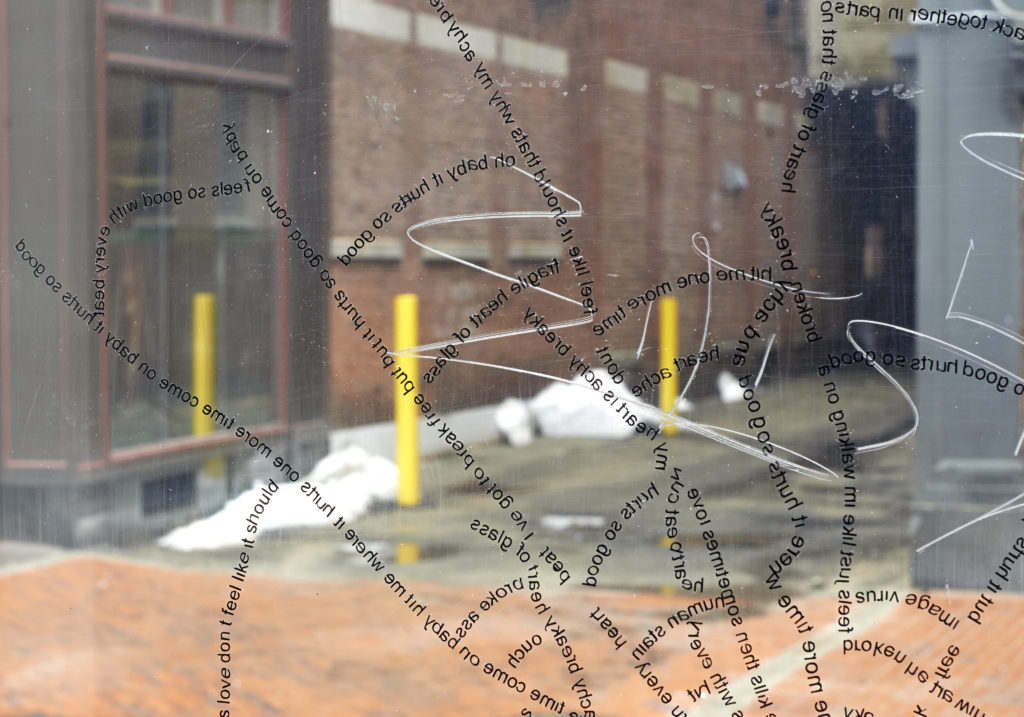
Achy Breaky looks at the relationships between love and destruction through a concrete poem collaged with song lyrics from Billy Ray Cyrus, John Mellencamp, Queen, Blondie and Britney Spears to explore the relationship of human emotion attributed to entropy and destruction in popular culture. By combining these lyrics that describe either a notion of love that is considered subversive or destructive or both (“sometimes love don’t feel like it should”), Achy Breaky looks to relate a relationship of love and desire to architecture, urban space and a viewing experience.
By creating a trompe l’oeil effect of a broken window, the work is attempting to anthropomorphize the architecture of the gallery through poetry. The criminological theory of Broken Window Theory which describes derelict urban spaces as hot beds for criminal activity, while introduces a system of the policing these spaces through visual maintenance. Achy Breaky reflects the persistent sterilization of urban space as somehow an attempt to fight against a human condition, while equating the process of policing aesthetic value as the same as regulating individual concepts of love and lust.
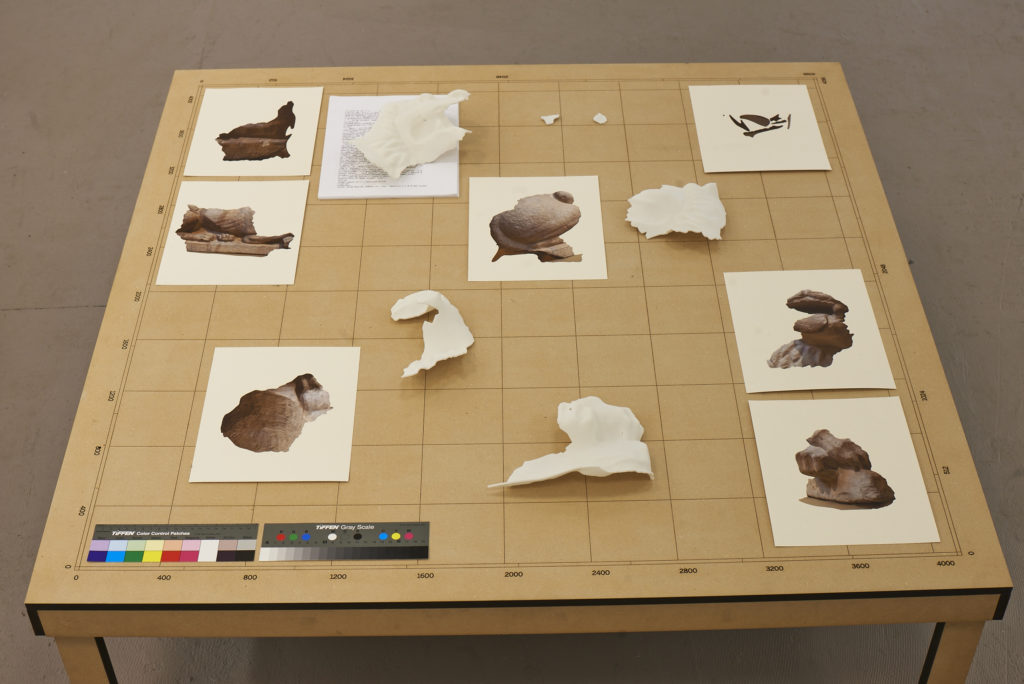
This texture map was just extracted from a 3D model that is publicly available map was just extracteq on the community website for Autodesk’s 123D Catch-a software that creates 3D models from photographs. Texture maps are 2D images used by the computer to skin the 3D model and make it appear realistic. The result is an image never before been seen by human eyes. Now that it has been extracted, the nature of the image has changed-from a means to an end. To mark that change, tex_ archive has catalogued the image in the Library of Congress, via Twitter.
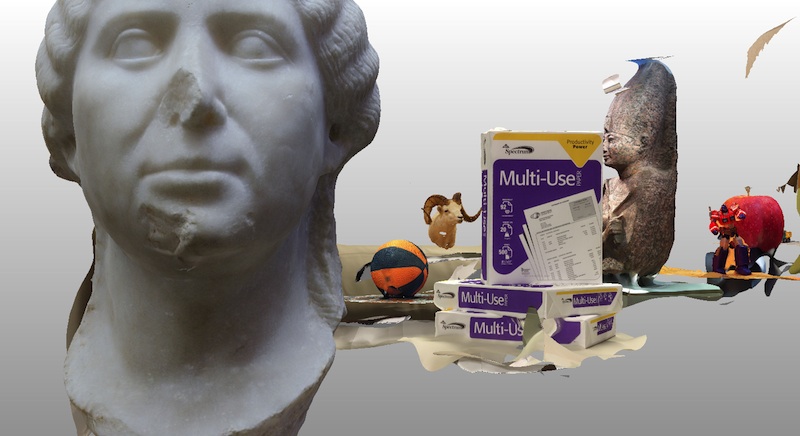
A digital artifact is neither an object nor its representation but the distance between the two. In this way a digital artifact exists somewhere between the two dictionary definitions of its material predecessor: 1. any object made by human beings, especially with a view to subsequent use. 2. a spurious observation or result arising from preparatory or investigative procedures. It is neither the object nor the observation, but the record of how a specific mode of observation has interfaced with an object and its context. The artifacts under consideration here were recovered from the community site maintained by the Autodesk software 123D Catch, which automates the process of translating user submitted photographs of people, places, and things into three dimensional models. The logic of digital conservation would seem to defend its sites against every material stress; 3D models are not eaten away by time or biology and they are not worn down by use, rather they proliferate because of it. Still, most of these artifacts apparently bear signs of deterioration and decay: they are perforated, imbricated with debris, hollowed out, and broken into shards.
Like the junk-piles known as middens to archaeologists, the 123D Catch site paradoxically conserves its objects at the moment of their fragmentation. But if a midden grows out of cast-off objects, broken as they are discarded haphazardly as refuse, here the artifacts are fractured by the opposite force: not by inattention but a moment of intense technological attention. That is, what manifests as material distress is only the product of the specific features and limitations of 123D Catch’s way of seeing. What 123D preserves, the artifact in question, is a field of technical vision. In other words, what 123D catches is itself. At this point the archaeologist realizes that their normal method must be inverted entirely. The goal is no longer to piece together their fragments into an approximation of a whole nor to keep digging to discover what might still be missing. Now the archaeologist must suspend the fragments as they are, understanding that what remains missing is already the discovery. What precisely can be recovered from the artifacts of this form of technical vision? Immediately we notice the technology’ s inability to distinguish between figure and ground, object and setting. This is revealed in two characteristic forms of debris: small indistinct shards orbiting the main object around all axes and larger semi-recognizable slivers agglomerated to the sides of the main object. The intrusion of the ground into figure catalyzes an ontological decomposition: as a cup melds into the table it lays upon, pieces of the furniture behind it, et cetera its relationship to its anthropocentric identity begins to dissipate. A single human-legible object is overwritten by a constellation of algorithmically motivated resemblances.
Just as frequently, the artifacts suffer from arbitrary subtractions: planes are pocked with holes, and volumes are cut through by deep channels. The program’s failure to render continuous surfaces often results from shadows cast by uneven lighting, an extension into three dimensions of the basic photographic problem of under/over exposure in high-contrast scenes. Tutorials for 123D catch suggest photographing objects in flat, even lighting to minimize shadows. In other words, in order to accurately capture the dimensionality of an object, the program requires users to eliminate one of the most fundamental visual cues for the human perception of dimensionality. With the exception of relative size, shadows and shading typically provide the most information about depth, especially in static representations: a sculpture lit evenly against a uniform background may appear flatter than a painting of a sculpture witha convincing shadow. The means of approximating and reproducing a volume by the software is then diametrically opposed to its counterpart in human vision. 123D Catch requires its users to practice a particular kind of photography whose goal is to produce machine readable information rather than anthropocentric resemblances. This distinguishes the process from its superficially similar predecessors in forensics and archaeology; these were earlier forms of so-called photogrammetry that attempted to create photographs containing the maximum amount of quantifiable measurements such as scale, color, and texture. While these practices instrumentalized photography as data, the data still only had to be legible to a subsequent human investigator or researcher. At the most schematic level, this mode of photogrammetry placed the technical apparatus of photography as a medium between two diachronic human subjects: the historical subject who created the artifact and the present or hypothetical future analytical subject.
In the case of 123D catch, the diagram is reversed. The human operator of the camera becomes the interlocutor for the communication between two technical subjects: the camera on the one hand, and the modelling software on the other. The technical logic of their subjectivity becomes the lingua franca that the human must learn how to speak. The 123D system catch re-educates the human subject on the meaning and use of photography. Put another way, if those features in these 3D models that appear to the human viewer as mistakes are most easily attributed to this system, they might just as accurately be redefined as errors made by the human in comprehending a new definition of photography.
– Clement Valla and AE Benenson for Some Sites and Their Artifacts: 123D Catch
Ian Hatcher Throws Generative animation with unicode characters
Not Sorry
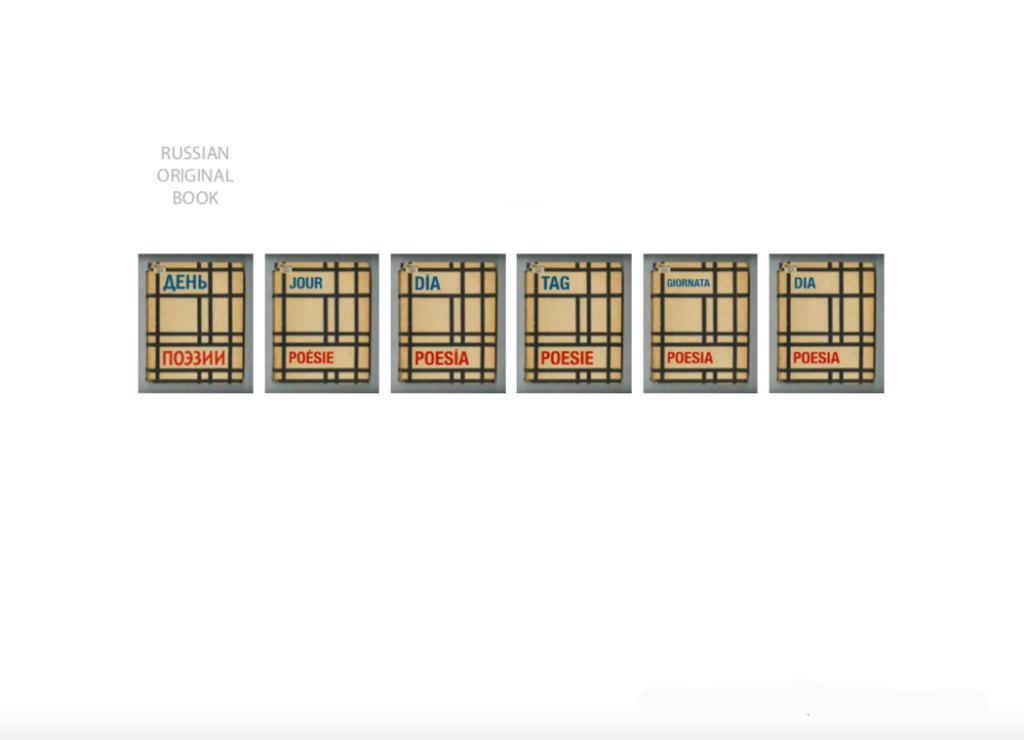
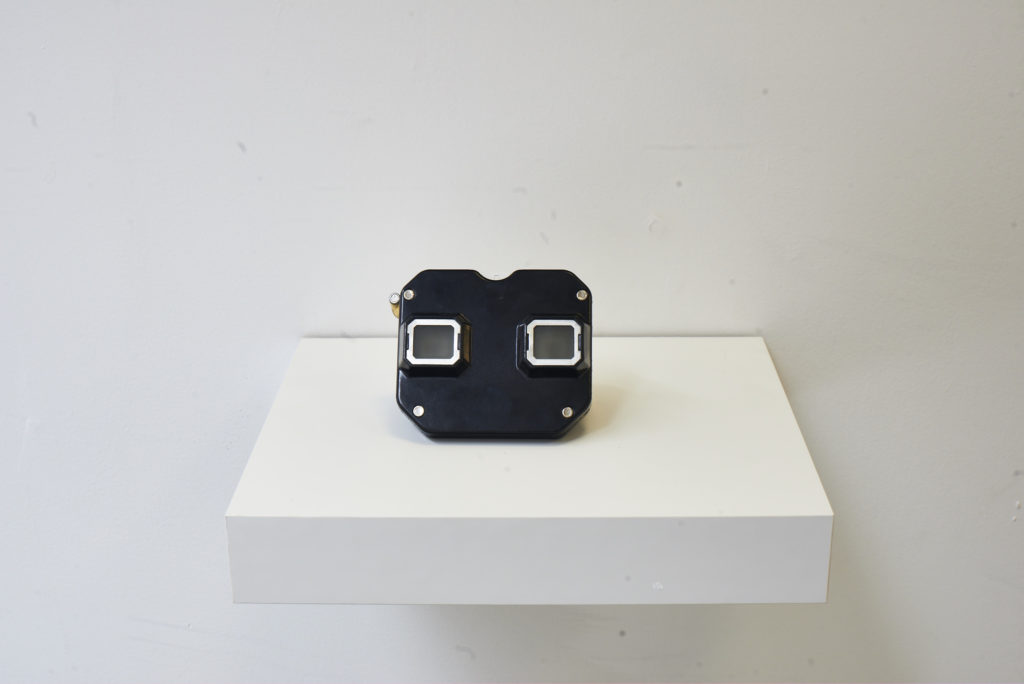
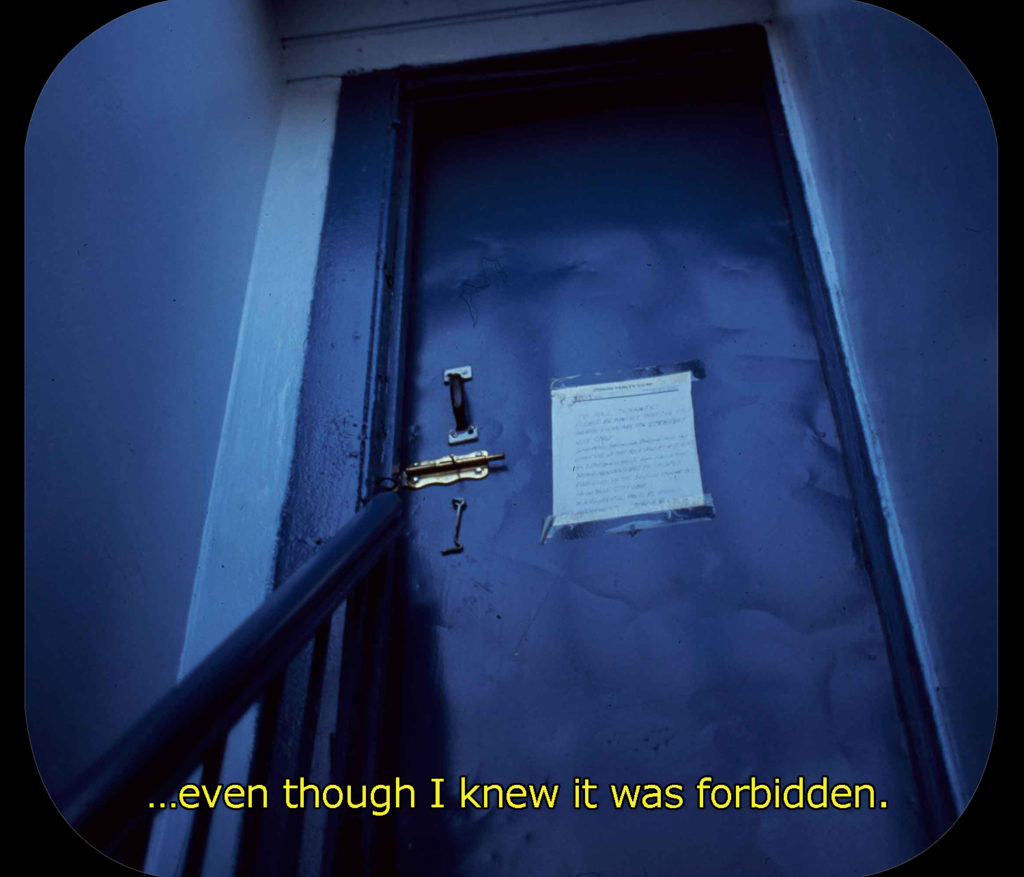
NOT SORRY Sophia Le Fraga 2015 · view-master reels, edition of 2 A collaboration with Rin Johnson Presented on the occasion of Interrupt 3: Maximum Sideline: Postscript
like images, chiaroscuro, looking/gazing out/at/on the horizon/border David Court 2015 · text; PDF Published alongside the artist’s installation of the same title in Interrupt 3: Maximum Sideline: Postscript.
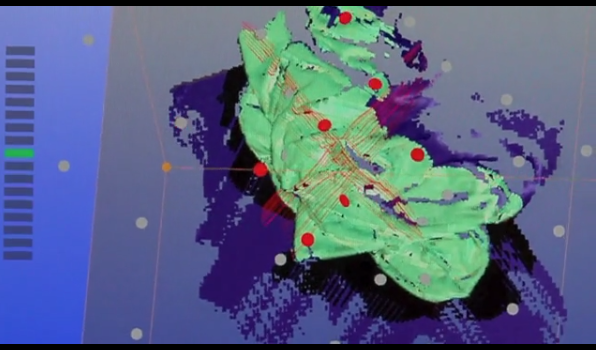
In like images, chiaroscuro, lookinggazing out/at/on the horizonborder, a chromakey bodysuit is being scanned by a handheld 3D scanner called the Z Corporation ZScanner 700 CX. From the lab specs: “The 700 СХ The 700 CX is a portable, non-contact laser scanner featuring a hand-held self-positioning scanning process, and is best suited for larger objects requiring multiple build passes. The 700 CХ саptures scan measurements of object geometries at a depth of field of 30 cm (12″) and at a sampling rate of 18,0000 measurements per second. The 700 CX offers XY accuracy up to 50 microns (up to O.002″) with a maximum resolution capability of 0.1 mm (0.004″) in Z.” The white dots on the suit are special adhesive reflective stickers called 3D scanning markers and function to enable the software to more accurately gauge shifts in the topography of the object.
Featured software in the second video is called Zscan, which displays the real-time capture of the data. It is capturing both bitmap data and vector data (which is the 3D model, which is a mesh composed of hundreds of thousands of facets). These two sets of info are or can be paired together in a 3D modeling program into a simulation of the material object. Or other bitmaps can be mapped onto the mesh as in the slideshow addendum to the piece.
For most situations, a single scan will not produce a complete model of the subject. Multiple scans, even hundreds, from many different directions are usually required to obtain information about all sides of the subject. These scans have to be brought into a common reference system, a process that is called alignment or registration, and then merged to create a complete model. This whole process, going from the single range map to the whole model, is usually known as the pipeline.
proh – li – tair – ee – uh – nize – ay – shun (3x) C…]
In a polygonal representation of a shape, a curved surface is modeled as many small faceted flat surfaces. Polygon modelsalso called Mesh models, are useful for visualization, for some CAM(i.e., machining), but are generally “heavy” (i.e., very large data sets), and are relatively un-editable in this form. Reconstruction to polygonal model involves finding and connecting adjacent points with straight lines in order to create a continuous surface.
A body in a chromakey suit simulates a vitality that seems everywhere lacking. The false promise of possibility. The obliteration of context and material social realities in our blank and depthless minds. Desire sutured to an empty space. The exhausting duplicity of appearance. The bifurcated logic of identity.
A body in a chromakey suit performs the bifurcated logic of appearance, the appearance that conceals this very logic, the rendering invisible of the body in the black box of the image. The externalization of contingency.
The internalization of the global production process. A process that simply wants to repeat itself. A loop. Machinic weaving.
my – owe – pee – ah (3x)
Intense pleasure in skill, machine skill, ceases to be a sin, but an aspect of embodiment. The machine is not an itto be animated, worshipped, and dominated. The machine is us, our processes, an aspect of our embodiment. … We are responsible for boundaries; we are they.
Wind Sonatas
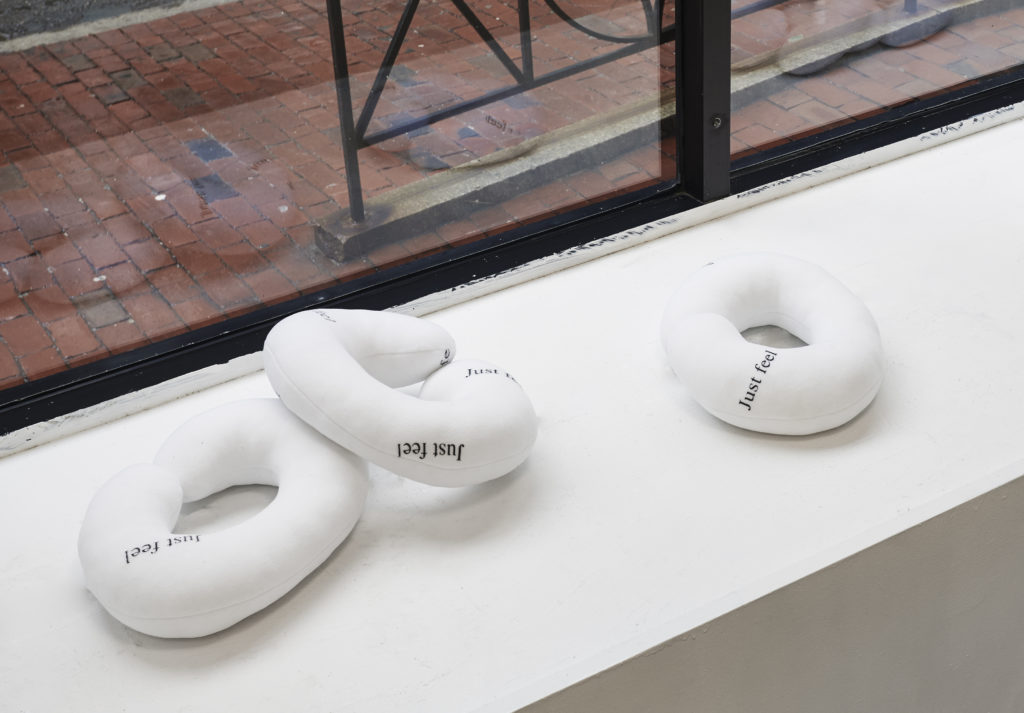
Wind Sonatas (long distance) Anna-Sophie Berger 2015 • writing, object edition; PDF Silkscreen on polyester fleece, wadding, thread Published on the occasion of Interrupt 3: Maximum Sideline: Postscript
Just feel
Finally a moment of quiet and peace at my general practicioner, where a selection of classical music awaits one in a spatious waiting room. I think about my sister not liking the wind sonatas. Later I am reading Artforum for the first time. I am worried about health as a placeholder. Till ultimately everything is resolved.
Remember that one time when I called you crying, lost in the fruit and vegetable section? I am confused I said.
Upon leaving the doctor I pass by this underwear store again, still wanting that nude colored bra-top-hybrid. I think it is one I could need, similar to the very model i am wearing now for 5 years. Choice within these measures stresses me. Knowing ones cup size and being ready for new products stresses me. I did like this once. I remember liking the capacity of finding a new thing i could like. I got weary, or deceived maybe when they changed the density of my favourite tights. Might be a cure though, it renders me suspicious to objects. (…)
Ok so this bra, it is now taking thouroughly long for me to be in peace with wanting it, measuring up to me needing it. And what is needing anyways? I get a little worried about this reluctance, since it feels like a teenager proofing a point.
Am I actually doing this to earn a sense of liberated pride for resisting, dealing with the roots of desire so to say? Or, alternately, am I depriving myself for unclear reasons, feeling ultimately sadder than if i did buy? But precisely, what are the roots of desire, what do i need? what kind of holiday do we book?
„Let’s go and buy you new sneakers” you said
But the feeling is precisely the one I have when on this webshop. The filters are the problem, too explicit are the questions they imply. Either extreme seems to match and not to match.
I confuse monday and sunday again. And I wanted you to tell me something soothing. Afterall, there is no logic to it. Then I watch the dancing goats video and try to eat some of the oats from on top of the bread.
Cotton makes me feel perfectly in place, wholesome and unpretentious. Adequately outlining a sort of unexcited state. Not without joy just not hysteric. And not staged. This grey long sleeve and that old sweater with the butterflies. They say cotton has a dry feel to it. it works maybe not for extremes, but precisely for the avarage situation of subtle importance. It makes decision quick, I feel capable of doing stuff when wearing it. Even at its thinnest quality, I feel less fragmental than when wearing silk.
The dress is on the small table in the small room, oh, or maybe it is in Vienna.
Lotuff Leather, Brazil SS15
Brazil SS15 Lindy McDonough, Lotuff Leather 2015 · photographs; PDF Photographs from a trip to Brazil, where Lotuff’s leather is vegetable-tanned using eucalyptus oil. Published on the occasion of Soft Industries
Lotuff Leather is an in-house leather atelier hand-making luxury bags in Providence. From sourcing the best vegetable-tanned leather in the global market to classically assembling the pieces, her team of artists and makers strives for perfection over expediency and takes great pride in being an American manufacturer. Lotuff’s timeless designs are available at 72 retailers worldwide—from the first floor of Barneys to Moda Operandi—and have been lauded by The New York Times, Vogue, Buzzfeed, Bloomberg and Conde Nast Traveler. The No. 12 Weekender earned GQ’s best duffle three years running, and Fashionista has highlighted the studio’s sustainability practices.
Four White Walls and a Sermon 2013 · booklet; PDF Images and interviews with Rubens Ghenov, Duane Slick, and Martin Smick. Design by Everett Williams. Published on the occasion of the exhibition at 379 Broome Street, New York
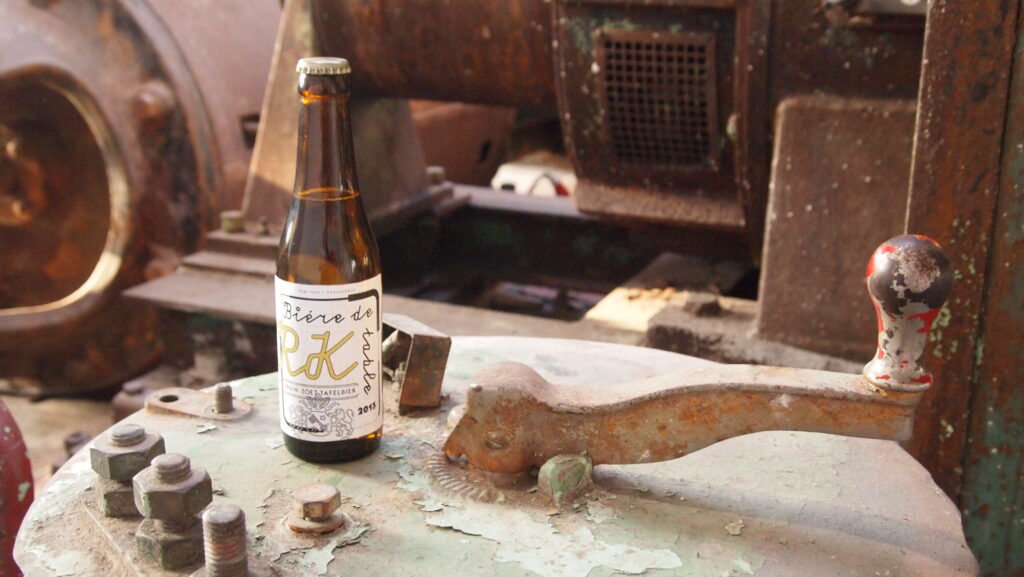
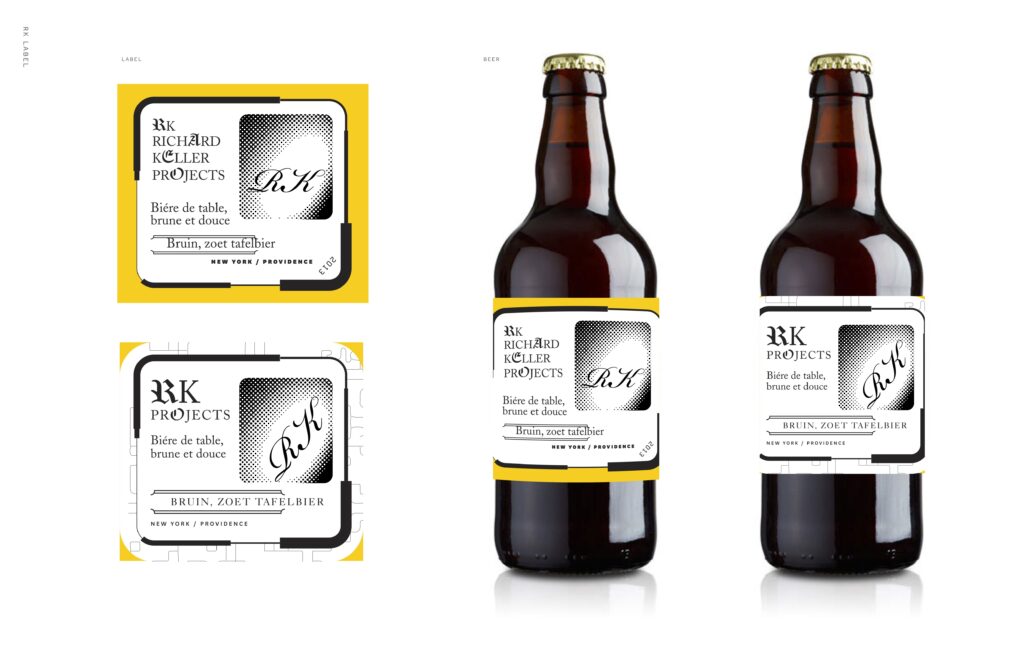
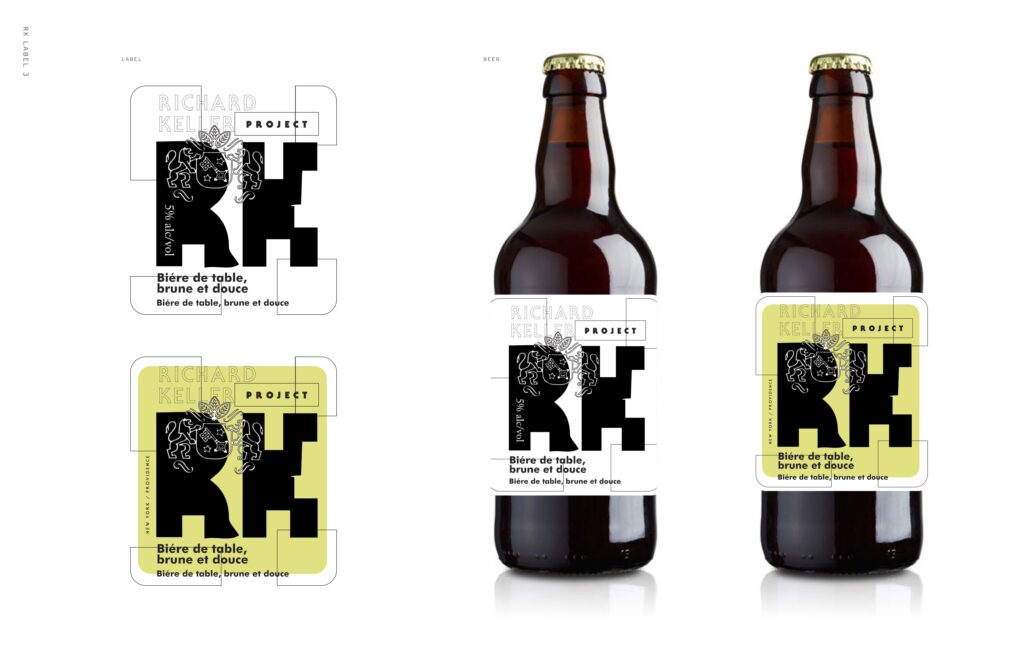
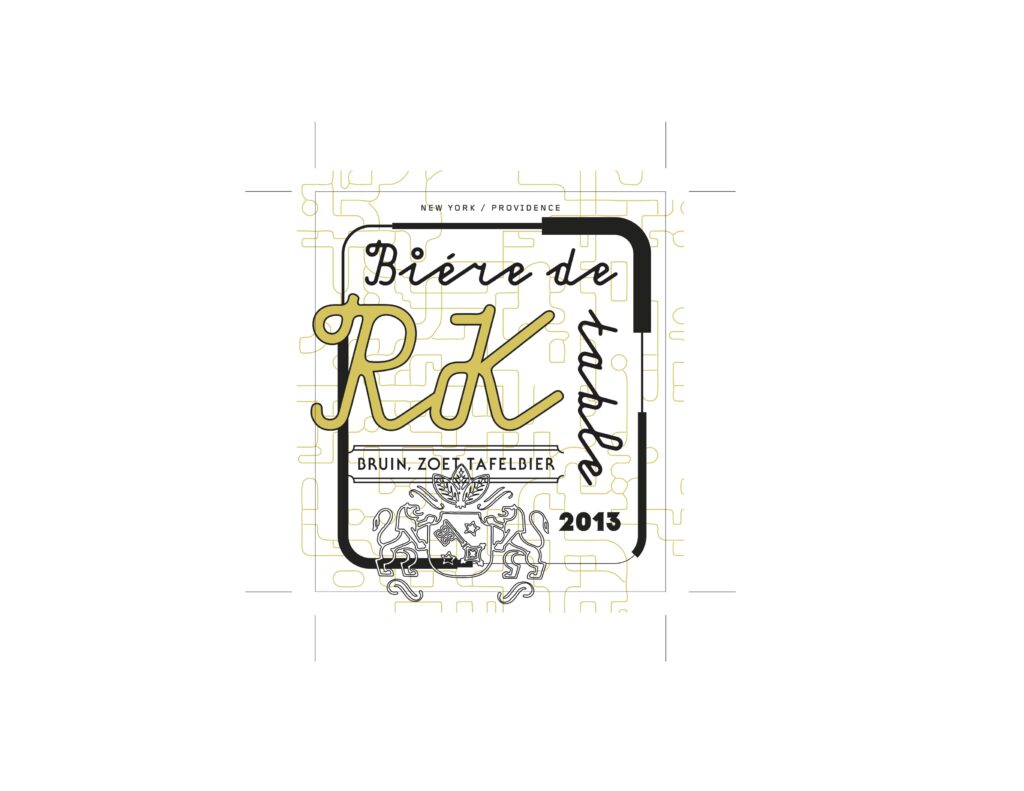
Limited-Edition Beers American Pilsner, Strawberry IPA, Berliner Weisse 2013 · homebrewed beer, edition of 30 Label design by Jeff Hale. Produced for Kunst Promenade at Poppositions, the off-site fair held during Art Brussels.
Don’t Let Me Down, zine
Don’t Let Me Down 2012 · zine; PDF Nick Carter, Fraser Evans, Kelly Zutrau. Published on the occasion of the exhibition at 204 Westminster, 2nd Floor, Providence
curvilinear declination mind sweep
CURVILINEAR DECLINATION MIND SWEEP Stefan Gunn 2012 · print/broadside/zine; PDF Published on the occasion of Per Infinity, 204 Westminster Street, Providence
Sleep/Vexations Handbill 2012 · offset print; PDF Design by Dan Brewster. Produced for an off-site screening of Andy Warhol’s Sleep and a performance of Erik Satie’s Vexations (1893), presented in collaboration with Magic Lantern Cinema at 42 Rice Street, Providence