
Surface Survey
Clement Valla
2015 · text; PDF
Published alongside the artist’s installation in Interrupt 3: Maximum Sideline: Postscript.

74.51.2868 (Limestone recumbent lion), 2014
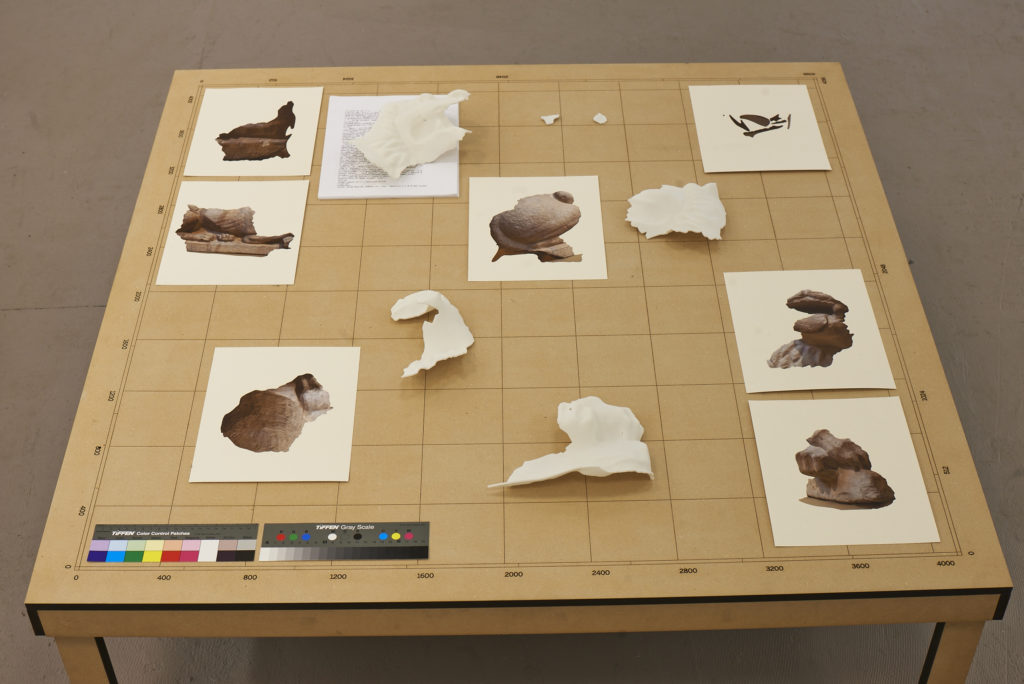
This texture map was just extracted from a 3D model that is publicly available map was just extracteq on the community website for Autodesk’s 123D Catch-a software that creates 3D models from photographs. Texture maps are 2D images used by the computer to skin the 3D model and make it appear realistic. The result is an image never before been seen by human eyes. Now that it has been extracted, the nature of the image has changed-from a means to an end. To mark that change, tex_ archive has catalogued the image in the Library of Congress, via Twitter.
A digital artifact is neither an object nor its representation but the distance between the two. In this way a digital artifact exists somewhere between the two dictionary definitions of its material predecessor: 1. any object made by human beings, especially with a view to subsequent use. 2. a spurious observation or result arising from preparatory or investigative procedures. It is neither the object nor the observation, but the record of how a specific mode of observation has interfaced with an object and its context. The artifacts under consideration here were recovered from the community site maintained by the Autodesk software 123D Catch, which automates the process of translating user submitted photographs of people, places, and things into three dimensional models. The logic of digital conservation would seem to defend its sites against every material stress; 3D models are not eaten away by time or biology and they are not worn down by use, rather they proliferate because of it. Still, most of these artifacts apparently bear signs of deterioration and decay: they are perforated, imbricated with debris, hollowed out, and broken into shards.
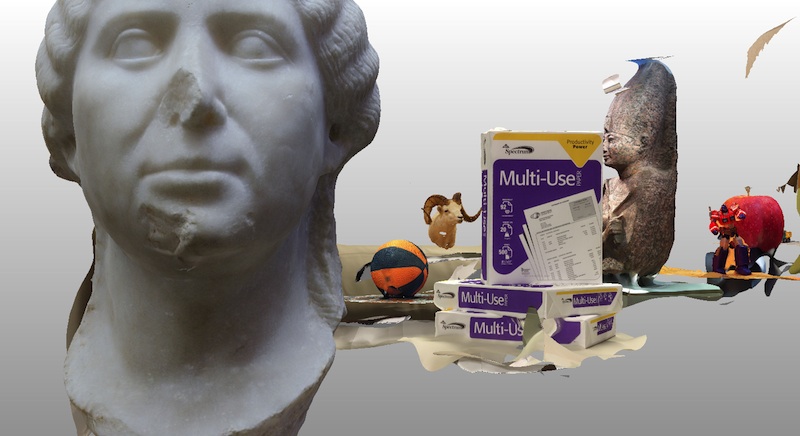
Like the junk-piles known as middens to archaeologists, the 123D Catch site paradoxically conserves its objects at the moment of their fragmentation. But if a midden grows out of cast-off objects, broken as they are discarded haphazardly as refuse, here the artifacts are fractured by the opposite force: not by inattention but a moment of intense technological attention. That is, what manifests as material distress is only the product of the specific features and limitations of 123D Catch’s way of seeing. What 123D preserves, the artifact in question, is a field of technical vision. In other words, what 123D catches is itself. At this point the archaeologist realizes that their normal method must be inverted entirely. The goal is no longer to piece together their fragments into an approximation of a whole nor to keep digging to discover what might still be missing. Now the archaeologist must suspend the fragments as they are, understanding that what remains missing is already the discovery. What precisely can be recovered from the artifacts of this form of technical vision? Immediately we notice the technology’ s inability to distinguish between figure and ground, object and setting. This is revealed in two characteristic forms of debris: small indistinct shards orbiting the main object around all axes and larger semi-recognizable slivers agglomerated to the sides of the main object. The intrusion of the ground into figure catalyzes an ontological decomposition: as a cup melds into the table it lays upon, pieces of the furniture behind it, et cetera its relationship to its anthropocentric identity begins to dissipate. A single human-legible object is overwritten by a constellation of algorithmically motivated resemblances.
Just as frequently, the artifacts suffer from arbitrary subtractions: planes are pocked with holes, and volumes are cut through by deep channels. The program’s failure to render continuous surfaces often results from shadows cast by uneven lighting, an extension into three dimensions of the basic photographic problem of under/over exposure in high-contrast scenes. Tutorials for 123D catch suggest photographing objects in flat, even lighting to minimize shadows. In other words, in order to accurately capture the dimensionality of an object, the program requires users to eliminate one of the most fundamental visual cues for the human perception of dimensionality. With the exception of relative size, shadows and shading typically provide the most information about depth, especially in static representations: a sculpture lit evenly against a uniform background may appear flatter than a painting of a sculpture witha convincing shadow. The means of approximating and reproducing a volume by the software is then diametrically opposed to its counterpart in human vision. 123D Catch requires its users to practice a particular kind of photography whose goal is to produce machine readable information rather than anthropocentric resemblances. This distinguishes the process from its superficially similar predecessors in forensics and archaeology; these were earlier forms of so-called photogrammetry that attempted to create photographs containing the maximum amount of quantifiable measurements such as scale, color, and texture. While these practices instrumentalized photography as data, the data still only had to be legible to a subsequent human investigator or researcher. At the most schematic level, this mode of photogrammetry placed the technical apparatus of photography as a medium between two diachronic human subjects: the historical subject who created the artifact and the present or hypothetical future analytical subject.
In the case of 123D catch, the diagram is reversed. The human operator of the camera becomes the interlocutor for the communication between two technical subjects: the camera on the one hand, and the modelling software on the other. The technical logic of their subjectivity becomes the lingua franca that the human must learn how to speak. The 123D system catch re-educates the human subject on the meaning and use of photography. Put another way, if those features in these 3D models that appear to the human viewer as mistakes are most easily attributed to this system, they might just as accurately be redefined as errors made by the human in comprehending a new definition of photography.
– Clement Valla and AE Benenson for Some Sites and Their Artifacts: 123D Catch