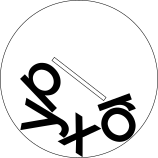
like images, chiaroscuro, looking/gazing out/at/on the horizon/border
David Court
2015 · text; PDF
Published alongside the artist’s installation of the same title in Interrupt 3: Maximum Sideline: Postscript.
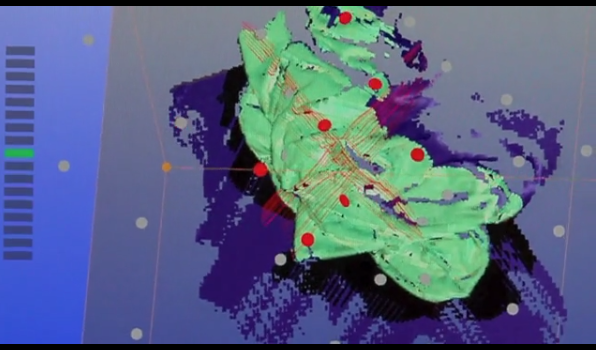
In like images, chiaroscuro, lookinggazing out/at/on the horizonborder, a chromakey bodysuit is being scanned by a handheld 3D scanner called the Z Corporation ZScanner 700 CX. From the lab specs: “The 700 СХ The 700 CX is a portable, non-contact laser scanner featuring a hand-held self-positioning scanning process, and is best suited for larger objects requiring multiple build passes. The 700 CХ саptures scan measurements of object geometries at a depth of field of 30 cm (12″) and at a sampling rate of 18,0000 measurements per second. The 700 CX offers XY accuracy up to 50 microns (up to O.002″) with a maximum resolution capability of 0.1 mm (0.004″) in Z.” The white dots on the suit are special adhesive reflective stickers called 3D scanning markers and function to enable the software to more accurately gauge shifts in the topography of the object.
Featured software in the second video is called Zscan, which displays the real-time capture of the data. It is capturing both bitmap data and vector data (which is the 3D model, which is a mesh composed of hundreds of thousands of facets). These two sets of info are or can be paired together in a 3D modeling program into a simulation of the material object. Or other bitmaps can be mapped onto the mesh as in the slideshow addendum to the piece.
For most situations, a single scan will not produce a complete model of the subject. Multiple scans, even hundreds, from many different directions are usually required to obtain information about all sides of the subject. These scans have to be brought into a common reference system, a process that is called alignment or registration, and then merged to create a complete model. This whole process, going from the single range map to the whole model, is usually known as the pipeline.
proh – li – tair – ee – uh – nize – ay – shun (3x) C…]
In a polygonal representation of a shape, a curved surface is modeled as many small faceted flat surfaces. Polygon modelsalso called Mesh models, are useful for visualization, for some CAM(i.e., machining), but are generally “heavy” (i.e., very large data sets), and are relatively un-editable in this form. Reconstruction to polygonal model involves finding and connecting adjacent points with straight lines in order to create a continuous surface.
A body in a chromakey suit simulates a vitality that seems everywhere lacking. The false promise of possibility. The obliteration of context and material social realities in our blank and depthless minds. Desire sutured to an empty space. The exhausting duplicity of appearance. The bifurcated logic of identity.
A body in a chromakey suit performs the bifurcated logic of appearance, the appearance that conceals this very logic, the rendering invisible of the body in the black box of the image. The externalization of contingency.
The internalization of the global production process. A process that simply wants to repeat itself. A loop. Machinic weaving.
my – owe – pee – ah (3x)
Intense pleasure in skill, machine skill, ceases to be a sin, but an aspect of embodiment. The machine is not an itto be animated, worshipped, and dominated. The machine is us, our processes, an aspect of our embodiment. … We are responsible for boundaries; we are they.